Results of the August 2026 Toki Pona census
Go here for a list of pointers to resources mentioned in the census.
How has the Toki Pona community changed since August 2024? What about their numbers? Do people often visit ma pona pi toki pona? Do they meet up with other tokiponists? What books do they own? Find out about this and much more in the results of the fourth Toki Pona census!
August 08, 2026. After 2 years since the third census, we released this one on Toki Pona’s anniversary. We closed it after about 6 weeks, as last times, receiving 1419 responses, which is 29% less than last time. There are a few conjectured reasons for this drop: one is that other two large surveys were released on the same day and people were probably not receptive to so many forms. It’s been discussed to separate the release of big surveys in time in the future. Another possible reason is that Toki Pona is getting fewer people now than it used to be. It seems that most people learned about the existence of Toki Pona online, where youtube played a big role. Even though Toki Pona content is increasing, there may not have been enough content promoting Toki Pona to the world lately, or the internet is pulling everyone’s attention to something else. These are only conjectures though, take them with a grain of salt.
Hi, I’m jan Tamalu and I have coordinated this project, analyzed the data, and made this post. Many people contributed to this project, such as jan Alonola, mun Kekan San, kala Asi, jan Jonatan and jan Tepo.
This time, we had some new questions and others were slightly modified. People could decide to only answer a few of the questions, although most people reply to almost everything. The turnover of people responding to the census was again very high with 66% not having responded to a previous Toki Pona census, establishing again that lots of people come and go in the Toki Pona online community. o alasa e sona pona a!
What to know before jumping to the results:
-
Tap/click on the graphs on small screens to reveal missing info, like bar labels.
-
Each question has (1) a graph with results from all the responses (including tp respondents) and (2) one with results from the people that used the Toki Pona version of the form.
-
Questions marked (MA) in the title allowed multiple answers. Their percentages can add up to more than 100%. We also wrote the number of people that answered each question.
- Free-text answers were randomly shuffled.
Intro
Language used
As last time, we used a Google form in English and Toki Pona and a Tencent QQ form in Chinese and Toki Pona. About one fifth of respondents used the Toki Pona form: 20.7%, up from 16.1% in 2024. The proportion has risen in every census so far. The Toki Pona-only charts have a useful sample of 294 responses, including two from the Tencent QQ form.
Btw, I created a Discord server for playing and contributing to a game inspired by Toki Pona designed to grow the Toki Pona community. This is a post about it.
Sections filled
People could leave after any section, and 85.6% reached the fourth one. This is slightly below the 89.4% completion rate from 2024, which could be due to the census being a bit longer this year.
Toki Pona ability
Do you consider you know Toki Pona?
Anyone with any level of Toki Pona could respond to the census, including people who had only just started learning. Even so, about 85% now say that they know Toki Pona, compared with about 80% in 2024 and 74.2% in 2022. This is one of the clearest continuing changes across the censuses. There were three brave people that went for the Toki Pona form that marked they do not consider they know Toki Pona.
Did you answer previous Toki Pona censuses?
About 66% were filling a Toki Pona census for the first time. This is still a large majority, although it is lower than the 77% observed in 2024, now that there are three previous censuses one could have answered. The turnover is again smaller in the Toki Pona group: 45% selected ala. Of all respondents counted here, 32% had answered the 2024 census, while a very small minority had answered an older census but not the 2024 one.
Recent visits to ma pona pi toki pona
This question is new. We wanted to know how many respondents were around recently in the main Discord server. The answer is almost identical for the Toki Pona group and the full one.
Toki Pona level
The distribution has again moved towards the higher Toki Pona levels. About 61% report at least an intermediate level, compared with 53% in 2024 and 44% in 2022. Advanced and fluent answers together also rose from about 20% to 24% since 2024. As expected, the Toki Pona respondents report a greater level.
How many Toki Pona people have you spoken with, and have they visited ma pona recently?
Two questions were made to see if we could obtain a nice lower bound on the number of tokiponists using a variant of the scale-up method of indirect surveys. There will be a separate post explaining our findings and our method, since it differs from the classical scale-up method that tries to estimate the exact number and not a lower bound.
We asked how many people you know “interested in learning/using Toki Pona that you have ever had a conversation with? (online or in person, in any language)”, and to report that number split by their level: (A) None / hasn’t started learning (B) Beginner/Learner/Intermediate (C) Advanced/Fluent. These categories are defined in the previous question. We also asked “Out of those people how many do you think have visited the ma pona pi toki pona Discord in the last 3 months?”. Then, we use the number of real visitors to ma pona to extrapolate.
There were 1071 responses, after excluding invalid ones, and 41% of them reported at least one beginner-to-intermediate person who had recently visited ma pona, and 46% knew at least one advanced or fluent visitor. The reach is much higher in the Toki Pona group. Only 25 respondents described their own level as None, and they knew 9 people at level A (none/not started), 7 at level B (beginner/learner/intermediate), and 11 at level C (advanced/fluent). They estimated that 2, 4, and 5 of those people, respectively, had visited ma pona in the previous 90 days. Below in the plots, you can see the responses for the people with levels Beg.-int. or Adv-fl. about the people they know and their level A, B, or C. Dark blue represents how many people were estimated to have visited ma pona.
Note that the total sum are not different people: two individuals knowing the same person would add 2 to the count. But I’ll advance that the statistical method that accounts for multiplicities seems to estimate a lower bound of something between 5000 to 10000. This is only a lower bound of what we could reach with this survey. The future post that we’ll publish on this website will contain the in-depth analysis, with the math behind it and the more concrete response, along with confidence intervals of this statistical analysis.
You can also open the section below to see another visualization of the data.
Per-respondent distributions
This version of the plots separates each of the six bars into two distributions, producing 12 box-and-whisker rows. The label ma refers to the respondent’s estimate for recent ma pona visitors and not to the remainder. Each box contains the middle 50% of responses, the dark line is the median, the whiskers use the usual 1.5 interquartile-range rule, and dots are outliers.
Days to reach an intermediate reading/writing level
This is a cool new question. People often wonder how long it takes to get to an intermediate level of Toki Pona. In blue, we can see the self-reported days for achieving such a feat for reading/writing. On the right, we can see the number of days studied so far if the current level was lower. After the charts, you can see comments people wrote on their number.
About 67% placed themselves within the first six months and 84% within the first year. Among people below intermediate, 55% had been studying for at most 30 days. We excluded invalid answers from the plots.
Recall that we (loosely) defined what an intermediate level is in a previous question.
- 200, maybe? I have NO clue tbh
- 2, I am, as of answering this, merely a beginner.
- 200, about 6 months
- 30, I really took my time with it
- 30, I'm a quick learner
- 40, probably about 80-90 hours of work
- 21, max, been going on for years but with long breaks
- 50+? Can't remember, took a break from learning
- 5 days, but having a previous knowledge that came from failed previous attempts of learning
- 1095, give or take a few extra weeks
- 365, around a year ago
- 60, I memorized the vocabulary in a week, had my first conversations by week 2, and felt fairly comfortable with simple conversation in a couple months
- 60, ish
- 5, but there's a lot more where i just do gradual bits
- 10, been meaning to practice more and keep forgetting aaa
- 60, I've been learning on and off since 2022
- 120, but not intermediate yet
- 100, I don't really know, it's been kind of sporadic and spread out
- 165, Calculated from how many days it's been since March, in which I remember being the month I read lipu pu and instantly fell down the rabbit-hole.
- 30 days
- 30 days i think
- 300, I have no idea it's too long ago
- 15 days
- 3 Just started learning
- 30, Learner
- 913, I don't remember when I started learning and don't know if my skill is actually that good
- 30, comprehensible input is crazy useful!
- 660, it wasn't really linear and I took breaks
- 40, I'm not very sure though, and I also haven't practised much since, although I occasionally look at some things, mostly announcements in ma pona pi toki pona
- 100, I have no earthly idea because I’ve been off and on for 3 years with wayyyy more off than on
- 90, very approximated
- 730, estimated
- 7, as in probably roughly that many days containing a non negligible amount of learning/practice scattered across the past year
- 30, the example being 500 is making me less confident in this though
- 30, i used to know toki pona to an intermediate level and it's slowly deteriorated over the last 4 years
- 21, I have been self-learning it and gotten to an okayish level. I'm still nervous as heck about conversing, for various reasons.
- 0, i am still not intermediate skill
- 60, i learn casually and don't spend much time thinking about toki pona
- 0, why is this required :<
- 15, on and off, kind of sporadic studying
- 24, doing jan Misali's sona pi toki pona and repeating it once was enough
- 500+, I have memory issues though
- 30, If I only count days spent towards learning which were all in the beginning, but if I include all days since I started learning, somewhere between 200-300 days
- 300, about a year
- 700, I learned on and off
- 60, on-and-off learning between April and July 2024
- 17, but I wasn't really trying at first
- 200, thats an estimate tho. i started learning in 2021, have been learning on and off ever since
- 91, maybe
- 300 very very approximately
- 730, a couple years i think?
- 700, not actively learning most of those days
- 1000 but on/off
- 13 days so far
- 14, it took me 2 days to complete the wasona course and then i tried interacting with the kama sona server but i wasnt as good as i thought so i kinda "gave up", but i wanna get back to learning and interacting asap
- 90, i didn't practice much
- 60, this is only the time i've actively practiced toki pona
- 10, but theres like 3 months between each of em
- 500, indeterminate so really i’m guessing
- 400, I'll be blunt: I have absolutely no idea. That 400 is based on 'it probably took me like a yearish, maybe'
- 0, Can't say. Had periods of little and more intense study/use separated by long periods of not focusing on it at all.
- 538, approximation. I also haven't been studying or learning constantly in that entire time.
- 400, days of learning to get to intermediate reading/writing only
- 5 (train travel one day + a few days of practice)
- 100, not sure
- 150 On and off but I guess around that many days
- 1 to 2 months
- 120, more or less
- 2 months
- 400, so far, but I still consider myself a beginner.
- 一个月,那之后三个月没说过,复健用了几天
- 500, sporadic study
- 300, I left the server and came back and that's when I started to really not hear about anything new to learn about the language
- 300, emphasis on “approximately”
- 364, but my practice was spotty and there were periods of a few weeks where I did not practice at all.
- 676767, All questions are optional except for the first two.
- mute luka luka
- 70? Not sure, its been a while
- 30, intense study with lots of anki drilling, talking to others, and purposeful study practice.
- 5, I’ve only just started!
- 273, I could've reach my current level sooner if I wasn't busy lol.
- 365, if I've been learning/speaking this for for honestly over a decade now, it has to have been at least a year of cumulative learning and usage I'd imagine. I go moderate periods of heavy usage and then long periods of hiatus, so estimation is a little tricky.
- 4 years or so of very intermittent study
- 90~
- 4, memorization of terms going pretty okay so far
- 2 weeks, i guess?
- 60, cumulatively on and off
- 30, 2 years ago
- 62?
- 1000, i think of it a lot, i red on it a lot, and struggle to find irl partners :')
- 300, but over 3 years.
- 7, literally just started
- 500, not entirely sure as it was several years ago
- 300, i don't exactly dedicate time, i just occasionally check out some material
- 10, but I can barely speak toki pona
- 0, idk what you mean
- 400, not very consistent learning
- 60, i did not practice heavily but a little every day
- 2 month
- 90, estimated
- 30, using jan kekan san’s videos and simple practice
- 14, learning it on and of again for the past 3 years, but just started again 2 weeks ago
- 26, I don't really know
- 20-30???, I really really don’t remember, it’s been 6 years
- 1, hello i just got here
- 150,on and off over the past few years
- 60, at least? i genuinely have no idea my amnesia is pretty bad
- 60,approximate
- 7天,掌握了178个词汇及其道本图,自己写写日记、和AI辩论一下没啥问题,但是阅读一些长的文字(尤其是遇到那些比较地道的词组)就卡壳了,听力不太行
- 9 sona x á
- 150 (approximately)
- 100,approximate as I don't remember
- 150 (very rough approximation; mostly concentrated near the start, with scattered episodes of further practice since)
- 0, did not achieve intermediate+ level in toki pona
- 300, mainly using nimi.li and mKS's lessons
- 7,事实上目前还退化了
- 14, around? But I learn languages really fast
- 21, i kind of passed the interest quickly.
- 0, I would argue I'm close to but not meeting the above definition of intermediate
- 350, somewhere around a year of on-and-off playing with it.
- 30, it took me 2 days to memorize all the words but so many more days to truly master the language
- 1 day, i forgot it all though besides hello so I reported as not learned yet.
- 14, Learner
- 90, although my sitelen pona isn't as strong as my toki pona in general
- 150, i don't even know how to properly assess my skill level, nor do i entirely understand this question. i haven't used toki pona in a while, so do i count only the days ive actively used it or every single day since 5 years ago?
- 0, I don't know
- 90, i do not actively sit down and learn and i am a bit off from intermediate, i believe
- 0, i aint there yet
- 200, idk
- 30, haven't yet, am sure it'll be faster to read glyphs than remember words/speak
- 20,dedicated practice time
- 180, this is just an estimate
- 400, i'm honestly not sure about my level because i haven't conversed in spoken toki pona with anyone yet due to my lack of a working computer mic.
- 30? that is very hard for me to answer because i practice/d quite intermittently
- 100, hard to estimate because I'm intentionally taking it easy and taking long breaks when needed
- 45, approximately
- 30, no idea
- 200, I got the hang of everything pretty fast but it took some time to actually get used to speaking it
- 0, I'm still learning
- 50, I think
- 17, I spent my time exclusively devoted to learning for those 17 days
- 100, no clue how accurate that guess is, though, I was very on and off with my toki pona learning in the beginning and I am notably bad at estimating lengths of time.
- 30, still don't know all the words
- 365, or more
- 600, From when I joined MTPVR, on and off
- 200, at a guess
- 20, idk its been like a year since my last toki pona "phase"
- 90, I don't really remember
- 3, it was mostly memorizing words and chunks like "'kama sona' means learning"
- 50, used 12 days of toki pona, then word flashcards, and then read ma pona pi toki pona messages
- 9999; not applicable/not there yet
- 14, more or less
- 0, Not there yet
- 589, I have tried learning on and off so I’m not that great but im getting back into it, hopefully ill reach intermediate soon
- 150, technically I’ve been learning for a year but I wasn’t consistent at all
- 40 days
- 2 years or so on and off of immersion
- 没有掌握
- 243 or more
- 6, I only started a week ago and know very little thus far
- 365, i don't remember when i first started so this is a very very rough estimate
- 0, I have no idea, and I don't have any idea about the previous two questions, either; I almost gave up on the survey because you made numerical input mandatory for those questions, and gave no "don't know" option
- 20, mostly consisting of the time it took me to finish jan Misali's youtube course
- 1, still a beginner
- 700, i started in 2019 but had several years where i did not use tp
- 100, on and off since like march 2025, been using toki pona a lot more in my notes recently since it's been fun
- 60, only 14 days for basic, other for improvements
- 60, im not sure tho i was pretty inconsistent with it
- 100, I dropped it then picked it back up a year or two later, so probably 100 days of learning
- 200, that's very approximate I wasn't keeping count
- 180, didnt study very often
- 900, I've known it for a while but I don't use it often so if I'm counting about the number of days I actually spent time on it it'd be around 300.
- 0?
- 25~, I spent a lot longer but I haven't really focused on it so it's hard to measure
- 180, Hard to say exaclty where this level is. I could argue anything form 60-360
- 30, I've been into toki pona for longer, but took many breaks from learning
- 75 days roughly.
- 118? I think I've been able to speak/read toki pona for around 2-3 months at this point
- 492, I simply decided to start learning toki pona one sleepless night.
- 8, approximately because it was like a year ago and I gave up
- 100, complete guess as process has been incredibly non-linear
- 10, mi sona ala
- 100, i learned quickly but was stuck at 'la'
- 60, although I'm very unsure on that number
- 120 maybe? Idk
- 365, about one year after I first heard of Toki Pona
- 21, A few weeks maybe?
- 0, I’m barely able to speak it
- 50 (pracitced on and off since January)
- 200, on and off practice
- 10, hours summed up to 8-hour days
- 60, it's been difficult so far with real life
- 365, Im a bit of a slow learner lol
- 500, though this is a huge guess
- 40, very rough approximation
- 1200, I dipped in and out of the language for the first few years
- 7, I’ve only just started learning
- 60, spent about a month of going through a course and practicing, but didn't consider myself intermediate until a while later
- 10? I have a very bad memory...I'm not sure, sorry.
- 100 - very hard to tell, have studied on and off for ca 20 years! until wasona.com. I have basic skills now and might have put in 25-40 days last time, many more days before that, and then I might not yet be Intermediate+.
- 30, i think my reading is intermediate but my speaking is learner level
- 500 apx., mostly in 2020-2022 but more in depth in 2026
- 0, i dont understand the question sob
- 6, perhaps. I’d like to spend more time learning, but my interest/attention span waxes and wanes frequently
- 100, more or less, on and off.
- 90, just guessing because i didn’t actively study
- 60 maybe
- 1 what even is this question
- 100, I am still learning
- 110, About three and a half months, though I was not regularly trying to learn toki pona grammar every day or anything
- 60, a guess and I'm not quite at that level anymore
- 40, i’ve been learning off and on for years so i really dont know
- 90, to memorize the words with flash cards constructing sentences is still difficult
- 450, I really don't know if I count as intermediate but this is the point where I started feeling confident in reading and writing Toki Pona
- 50, maybe 16 consecutively and the rest in short bursts across multiple years
- 3, -intermediate
- 90, beginner
- 50, approximately
- 0, haven't counted and have been learning on and off
- 30, mostly a while ago, but su was a good portion of it
- 0? I dont understand the question. My previous answers are low because im new to the server
- 0don't remember
- 10 months continuous effort, various attempts before that
- 30, maybe
- 20 Adding up all hours
- 60, but i was more passively learning the language over that period of time
- 365 (roughly), I haven’t been keeping track
- 500, very rusty tho. haven't done stuff in a while
- 400, about a year or so
- 100000000, "All questions are optional except for the first two." you said. Well, you got a random number.
- 40, learned in just over a month in May 2026
- 60, one day of cramming one resource of grammar and the rest reading
- 0, not at that level.
- 45~ days
- 7 days
- 730, to get learner level
- 100, i am not there yet but i assume it wouldn't be that complicated with consistent studying
- 0, 0, 0
- 400, A general estimate
- 80, many big gaps of time in between
- 180, but I used toki pona for person use instead of talking to other people early on, so it probably would've been faster if I did - around 6 months is when I would say I was able to understand the gist of most texts in toki pona
- 100,I really have no idea because it was over a long period of time but not super consistently.
- 30, mi sona ala
- 120, i’m not sure
- 90, maybe? not sure
- 100, used to study it a while back but relearned it more recently
- 100, I spent half my free time doing toki pona stuff for the first few weeks, then I just had to think in it for a while.
- 600, I'm still learning mostly on my own
- 700, but I don't think I ever devoted large portions of a day to learning. toki pona. I would learn a little bit for maybe an hour a day for the first month, and then occasionally ask on the subreddit over the next couple years or so.
- 120, maybe 180
- 30, one month in and conversations are generally readable and the path to improving is easier to discover
- 40, tho some days I've practiced more than other
- 0, Not sure
- 2, I don't get the opportunity much
- 2?
- 10 days or less
- 3 years
- 150 - I don't sure
- 0,I never reached an intermediate level
- 500, not sure how many, but most writing not reading
- 700, two years ish studying
- 40, or so
- 350, I have fallen out of practice but was once much more fluent.
- 约390?
- 1461, on-and-off four years of study
- 30, I'm between "learner" and "intermediate" and I just started about 30 days ago
- 1, beginner
- 400, around 2 years with lots of days of nothing
- 50, its been really of and on so I lose skills frequently
- 1, About every third year i get a period where i learn some toki pona some minutes or hour a day for half a week. Other Times i just randomly see toki pona content.
- 365, depends on how much you practice!
- 30, i have no clue since i haven't tried very hard to learn
- 40, very much a beginner so while I did spend time it wasn't much
- 70, when I fully learned sitelen pona
- 450, more or less
- 0, I don't remember. It was over a decade ago.
- 2 weeks so far, can understand basic level phrases
- 600, It's been a few years and I don't remember anymore; this is only a rough estimate
- 300ish, memory is hazy.
- 60, maybe ive been learning for years at this point so i dont exactly know
- 3, to consider myself "Learner". I visited a couple guides when I first discovered it, but since then I mostly just dabble here and there. I'm not really trying to be conversational.
- 0 (not actual, I just had to start with a number) I started in April 2025. I have no idea when I got to an "Intermediate+ level". I think I got good within a month or so, but not Intermediate+. I don't get why this question is required, as the turning point could be very hard to define and "What level of ability in Toki Pona do you have?" is not a required question.
- 50,asynchronous estimate
- 100, mi kama sona e lawa en nimi pi toki pona lon tenpo suno 14, taso toki pona mi kama wawa meso la mi o lukin e toki mute pi toki pona o toki mute tawa jan pi toki pona
- 40, ? i dont understand the timeframe of this question lmfao these last few questions are confusing lol
- 200, I think? Though I'm not really keeping track so idk
- 500, i have no idea how to reply to this, im putting a number bc it requires me to. i did a bit of anki every day and engaged w the language in a very inconsistent way and mostly "acquired" the language, plus im messy w this stuff so i cant really estimate an amount of time srry.
- 1000 but on and off so probably like 100 non continuous
- 4, Non-consecutively because I watched content on it but only started getting into it now
- 5, we just got the official book and began learning
- 350-ish
- 15 days to learn, then semiregular practice over the course of 6 months or so
- 300, however i didn't really start acitvely conversing until the last few months
- 730, way over 2 years
- 1,I keep them in my flashcards but don't use it normally
- 0, N/A
- 170 but i only conversed with the friend and read pu pasi. didn't spend much learning
- 365+, I learned a lot a few years ago but lost a lot of it. Honestly, TP just isn't for me (far too restrictive), but I stay because the community is interesting and nice
- 0, i don't understand
- 100, it was a while ago so i really dont know
- 61, toki ale ni pi wile sona li nasa mute tawa mi
- 30-40 days
- 0I have no idea? sorry
- 60, I think? not much
- 100, Idk it's been super gradual the entire time. I didn't spend a lot of time learning, I spent more time using and sometimes reading
- 60, although i didn't really put in much time
- 7Not sure
- 10. I have only read the book and some sample material. I have never conversed in Toki Pona.
- 36, barely actually tried however
- 40, fluent
- 120ish
- 100, not intensive
- 50,over a year only counting active days not counting pauses
- 700, ken ni li ken mi pi lon ala. ken ni li suli.
- 20, stopped due to school exams
- 180,in binges between school/work but across roughly this span of time
- 600, it’s been an on-and-off process
- 32, but that was a long time ago and i knew more then.
- 40, approx. 20 minutes per day
- 40, I have no motivation for anything lol
- 40,approx?
- 30, basically been learning for about a month with a lot of pauses
- 5 hour learn the 123 words i guess
- 20, I’ve studied it on and off for a while though but probably 20 in total
- 200, but don't know exactly
- 356+ days
- 53, I’m a polyglot
- 42, the learning curve hurts
- 7? maybe. i was more interested a few years ago than i am currently, lost motivation over time. rip
- 0,mi sona ala
- 300, the words were easy but understanding sentences is hard
- 60, learning vocab and grammar was easy; actually using toki pona to converse (especially understanding what someone speaking toki pona is trying to say + being confident that I have correctly understood the meaning of what they are saying) is quite difficult
- 7, It's hard for me to focus
- 3 months
- 365, genuinely no idea but this is a required question
- 120, though it's been on and off and I'm both quite a slow learner with language and I've been swamped in schoolwork. I am still not at a level I'm happy with and I can only just barely hold a conversation about simple topics with all involved talking slowly.
- 600, I don't really understand the question
- 60, i honestly don't know ngl
- 120, or so idk it was a couple months (why is this one required lol)
- 360, though I'm very unsure because I have relearned toki pona multiple times in the past 5 (or maybe more) years
- 5, but i had another attempts to learn the language years before that were failed because of procrastinating
- 400, i genuinely started learning toki pona on accident, so this is literally just a guess
- 5 it took me days, but I gave up and tried to start learning over the course of a few years.
- 1900, all i know is ive been toki ponaing since 2021
- 0, I'm not an intermediate(+)
- 200, haven't been learning actively
- 40, this was not to a conversational level but rather to the point of being able to construct novel ideas from scratch due to understanding the relevant grammar rules and semantic spaces and how to apply them. At this point I could translate without referring to a source.
- 60, I really don't remember
- 30, I have been doing it on and off for 3 years now
- 60, days where i've spoken in toki pona or spent time learning toki pona
- 400, I learned a bit last summer and barely used the language for months. Then, a month ago, I started learning again. So total time actually learning was less than 3 months.
- 200, who knows?
- 7, learned grammar in about 2 days then learned from texting in ma pona
- 30, i've not prioritised sitelen pona but i use my own script instead
- 50 IDK been learning on and off for a couple years
- 1700, Still very much a beginner
- 100 approx.
- 300, inconsistent learning over 1.5 years
- 90, uhhh I guess about three months so far I'm still new
- 12, almost all free time spent learning/ practicing toki pona
- 365 days
- 14 (tenpo suno)
- 21, mi sona wawa ala. taso nanpa ni li ken
- 240, (4 months)
- 273, wile la toki namako
- 15, mi wile toki namako
- 14, mi kepeken tenpo suno luka luka tu tu la mi ken toki sitelen e ijo mute kepeken toki pona taso
- 180, mi kama wawa insa la mi moku e tenpo suno ni
- 913, taso mi sona ala pona e nanpa - nanpa ni li wawa lili a
- 400, tenpo mun wan anu tu la mi sona e nimi ale pi toki pona. taso tenpo ni la lawa mi li ken ala kute e kon toki pi jan ante. kama sona ni li wile e tenpo suno suli wan.
- 365. taso suno mute pi tenpo suli ni la mi pali sona ala.
- 365. tenpo mute la mi wawa ala. taso mi lukin e sitelen wan tan sitelen "o pilin e toki pona" la wawa insa li kama sin. nanpa tu la mi tawa tenpo kulupu la wawa mi li kama suli
- 400, mi kama sona lon tenpo suno ale ni ala. taso mi kama ken sona pona e toki pi jan ante lon insa tenpo mun luka. mi wile toki wawa la ni li wile e tenpo mute pi kama sona.
- 120, mi kama sona e nimi ale kepeken tempo mun 1, taso nasin toki li wile e tenpo mute.
- 31, taso mi sona pi wawa ala tan ni: ni li lon tenpo weka.
- 1 year, sike ni la mi kepeken mute a e toki ni
- 80, mi kama sona lon tenpo weka la, sona li weka tan mi. taso suno ni li ken.
- 90, mi kama sona lon tenpo weka a la nanpa li ken pakala
- 100, tenpo open la mi kama sona mute ala, mi kama sona lili kepeken tenpo lili tan musi taso
- 4 wawa suli
- 400, mi kama sona kepeken tenpo suli
- 60, open la, pini pi sike tenpo #2021 la, mi kama sona toki pona kepeken sitelen tawa taso, la nasin mi li nasa lon ijo. mi kama lon mpptp lon sike tenpo #2024 la mi kama toki tawa ijo ante pi toki pona la mi kama toki kepeken nasin pi jan mute
- 90? taso tenpo mute la, mi open kama sona li pini kama sona. ni la, mi sona ala
- 50, mi kama sona e nimi pu ale kepeken suno luka. mi kama toki tawa jan kepeken tenpo mute sin.
- 30 (mi sona pona ala e wile nasin ni)
- 800, very rough estimate
- 180, mi open li pini li open li pini lon tenpo mute
- 3, sike ma-suno 3
- 365, anu poka
- 30, mi kepeken ala lipu sona (mi kama sona kepeken toki)
- 2 years. mi "wawa insa" ala. mi sona lili e toki pona lon tenpo sike tu. taso mi kepeken lili e toki pona mi sona lili.
- 730, tenpo sike #1 mi la mi alasa kama sona kpkn x sona tna jan ante, tan mi taso, la sona mi li ike a a a
- 0, mi kama "wawa insa" ala. mi la mi wawa lili lon tenpo ni.
- 60, mi awen ala sona e tenpo wan ni.
- 70, lon la mi sona pona ala. wile sona ale ni pi nasin nanpa li nasa sewi tawa mi
- 700, tenpo tu wan la mi alasa sona wawa toki pona. tenpo nanpa wan en tenpo nanpa tu la, mi kama sona lili taso. tenpo tu wan la, pini la, sona mi li kama wawa.
- 20, tenpo ni la mi sona e nimi ale e nasin ale pi toki pona, taso mi sona ala toki e ijo mute
- 120(?), mi open e kama sona lon mun #8 pi sike #2023 li kama wawa insa lon open pi sike #2024. taso tenpo insa la mi lape lili lon kama sona.
- 365 wile
- 200, ni li pini lon tenpo mute. tan ni, mi sona ala
- 365, lon la mi sona ala, li pilin e ni: jan tu la kon pi "wawa insa" li ijo wan tawa jan nanpa wan, li ijo ante tawa jan nanpa tu.
- 80, taso mi sona ala, ni li lon tenpo weka
- 99999999999 mi sona ala.
- 180, wile la toki namako
- 40 ni li lon tenpo pini weka la sona mi li wawa ala
- 4, mi kama sona kepeken lipu sona kepeken kulupu pi toki pona pi ma Anku
- 600, mi sona ala e nanpa, taso mute
- 30, wile la toki namako
- 45, taso tenpo ni la mi jan pi wawa insa ala. tenpo pini la mi jan pi wawa toki pi mute ni: wawa toki mi pi tenpo ni li lili a. tenpo weka ni la ken mi pi toki pona li wawa insa. tenpo ni la mi wawa lili taso. taso, mi wile (sike a!) kama sona li wile kawa wawa e ken toki mi
- 200, taso mi alasa e sona pi toki pona lon tenpo ale ni ala (ken la nanpa suli nanpa wan la ni li 30 taso)
- 60,
- 365, ken toki li kama lon tenpo lili - taso - ken li kama wawa lon tenpo suli
- 300, nanpa ni li nanpa pi suno tawa tan suno sona nanpa wan. mi kama sona pona e toki pona lon suno ale ni ala. (this is the amount of days that have passed since my first lesson. I didn't spend all of them studying.)
- 123456789, mi sona ala
- 1 year
- 220+, mi sona ala e suno open, taso mi open kama sona lon tenpo mun nanpa 4-6 lon tenpo sike pini.
- 60? mi sona ala
- 1200, mi sona ala, taso pilin mi la mi "ken toki pona" lon tenpo sike wan anu tenpo sike tu.
- 97, anu nanpa poka... mi sona ala e lili ni.
- 400, taso mi awen kama pona
- 913, tenpo sike suli tu
- 365, taso mi sona ala. ale la mi awen kama wawa. ni la, mi sona ala e tenpo
- 90, mi sona ala e nanpa pi tenpo mute. mi sona e ni taso: tenpo mute a la mi kama sona e toki pona
- 60? mi open e kama sona li kama pona tawa tenpo kulupu poka
- 730, mi sona ala e tenpo seme. taso tenpo sike suno tu la, mi sona e ni: mi kama sona e toki pona insa li sona e nasin kepeken lon kulupu toki mute.
- 913, tan ni: tenpo sike 2.5 la tenpo suno li mute ni. lon la mi sona pona ala.
- 800, open la mi toki lili tawa jan la mi kama ala wawa
- 30, tawa ni: mi ken lukin e toki pona sitelen mi ken sona e kon ona mi ken toki pona pi ike mute ala. taso tenpo pini ni la wawa mi li lili kin; tenpo lon la wawa mi li kama suli la
- 0 (mi kepeken nanpa ni tawa ni: mi ken sitelen, ona li lon ala) mi sona ala, pilin tenpo mi li lon ala (my chronoception lwk dont exist)
- 8,mi open kama sona e toki pona lon tenpo suno nanpa 2017 anu 2018. taso, ni la mi kama wawa ala. tenpo sike 2023 la mi lukin e sitelen tawa pi jan Telekoman la mi kama wawa lili.
- 90, sona wawa la ken suli la sike tu
- 999 cannot parse "e" before "li"
- 200, mi kama sona la, kon li seli li kama lete li kama seli kin
- 100, taso mi wile la mi ken kepeken suno pi mute lili tawa ni.
- 90, taso mi kama sona lon suno ale ala. mi kepeken tenpo suli a tawa kama sona. mi open kama sona lon tenpo sike tu tu pini.
- 200 mi sona wawa ala. Mi ijo mute lon suno mute la, mi sona ala e mute ni: mi pali pi toki pona lon suno mi pute seme?
- 30, ? mi awen sona pi pona ala
- 40, wile la toki namako
- 300 days? It took me a while to really become good at tp
- 60, anu seme...? ni li pilin mi. taso, mi kama sona kepeken tenpo pi suli nasa. jan ante la tenpo ni li ken lili a
- 30, tenpo mun
- 800, ken la mi li kama sona ike. tenpo pi kama sona la mi jo ala e tenpo mute. tan ni la mi kama sona kepeken tenpo mute
- 15, taso mi awen kama sona e ni: seme la, pona pi toki pona mi li ken kama suli?
- 2,?? mi sona ala, mi open e kama sona toki pona lon tenpo sike... 2018?? taso mi weka e kama sona. mi awen e kama sona lon tenpo 2025 li kama sona e no kepeken tenpo suno 2
- 480 anu 500; mi open toki pona lon tenpo sike pini
- 90, taso pilin pi wawa suli li kama lon tenpo kama pi weka suli. mi kama sona e toki pona lon tenpo sike 2021. taso toki pona mi li awen ante li kama suli lon tenpo ale.
- 200, ken la mi toki anpa e ken mi
- 1 tenpo sike
- 30, wile la toki namako
- 720, mi wile e tenpo suno sike tu tawa wawa insa
- 180, mi sona wawa ala e tenpo open mi
- 48, lipu li wile sona e nanpa mute taso mi sona ala aaaaa!
- 1 month
- 30, wawa insa pi toki uta li kepeken mute tawa ni (tenpo suno ke ~75)
- 1000, taso msa
- 730. taso nanpa li nasa. tenpo suno ni la mi sona mute e toki pona. taso sona ale li lon ala.
- 120, msa
- 180, lon sike suno tu wan
- 60, taso mi sona ala wawa
- 1, tenpo sike suli wan. tenpo sike ni la mi kepeken mute e sona pi toki pona mi li toki tawa jan ante lon tenpo suno mute lon ma pona pi toki pona a
- 365, tenpo ni (365) la mi ken toki kepeken toki pona. taso awen la toki pona mi li kama wawa kin
- 20, I learned TP by translating a text without prior knowledge by looking up a dictionary. The translation spent me ~20 days. There are some grammartical flaws but I guess I became wawa insa after that. That was possible because of TP’s simplicity perhaps, but I really want to try to learn a natural language like that.
- 90, mi open kama sona li pini tan wile ala li open li pini lon tenpo mute.
- 700, mi sona ala. o kepeken ala nanpa ni. mi sona ala e nanpa pona.
- 6 (*tenpo mun)
How often is Toki Pona used?
The frequency distribution remains remarkably stable. About 47% use Toki Pona at least a few times per week, compared with 49% in 2024 and 47% in 2022. For the Toki Pona group it is 63%, again close to the value reported in both previous censuses.
Toki Pona skills
Every skill rose relative to 2024. For example, 63% now say they can speak Toki Pona and 53% understand spoken Toki Pona, up from 56% and 45%. Knowing all the pu words rose from 76% to 83%. This does not mean the community improved their skills overall, just that this year the people that responded have better skills. Listening remains the lowest bar.
Sign languages of Toki Pona
Luka Pona has the largest interested group, with 557 interested and 88 learning, but only 16 saying they know it. The proportions who know or are learning either system are close to 2024, but interest in Luka Pona has grown.
The same results on a logarithmic scale for easier clicking:
Why do people learn Toki Pona?
Having fun is still the main reason to learn Toki Pona by far: 81% selected it, although this is down from 88% in 2024. The Toki Pona group is different here, for the first time: becoming multilingual is its most common answer, ahead of fun.
I love to see in the comments “I will be paid £2 for learning it”. In the second census ever in 2022 as well as in 2024, someone had replied “I was paid £2”, which was very funny and also prompted me to offer £2 to a friend to learn Toki Pona, who accepted (not living in the UK myself I managed to get a £2 coin). Now, this year we see another person that will be paid £2 for learning Toki Pona, and I confirm that it is not my friend! a a a. Is this going to be a new trend in the community?!
- Because I thought it was easy.
- idk
- I was curious how the language worked with so few words
- I had time
- I wanted to understand conlanging and possibly design my own
- I wanted to know if it is really usable
- fuuuunnnnn
- A friend started some weekly toki pona lessons and I thought it would be pretty cool
- it really and truly captivated me!
- seemed easy
- Hobby to learn with my partner as a secret language
- thot it was cool
- to try an easy-to-learn international language, to push less English onto people
- I wanted to use it as a small component in my larger art projects
- To share a hobby with friends and see how easy/hard it would be to learn.
- I thought sitelen pona looked cool
- As a journaling language
- Language hyperfixation.
- Interested in languages in general, but toki pona's size makes it easier to commit to learning it to fluency
- it was interesting
- I wanted to test learning methods
- i'm interested in languages and conlangs
- I am learning it through vibes as a linguistics experiment with my gf
- impress girl on date
- I wanted to get closer to my friend who spoke it
- I was annoyed with how hard Japanese was and wanted to give my brain a break.
- I majored in German and have a minor in linguistics. So, I wanted to learn the linguistics nature of toki pona.
- A friend got me interested
- Getting ideas for conlangs
- Interested in using it in projects.
- It was interesting
- I wanted to see if it was really as easy to learn as I had heard
- Concept of a language with so little words was really interesting to my language loving brain
- Wanted to learn a minimalist language
- needed something to do over the summer
- Was in a conlang YouTube rabbithole and had nothing better to do
- Its interesting
- I have aphasia and I use fewer words than I used to.
- I don't remember
- I wanted to talk to my friends who spoke toki pona.
- i kept consuming toki pona translation content and accidentally started learning the language
- A friend spoke the language and wanted people to talk with
- My friend spoke it and reccomended I learn
- helped as a coping mechanism for dealing with the stress from my horrible family (both immediate and extended family) (I am safe, dw. I moved out lol)
- Writing in sitelen pona is useful in work situations since its 2-6x quicker than english and less straining for the hand
- I like conlangs but have never learned one
- Interesting language
- I loved the idea of a minimal language
- Taoistic idea of simplicity was what interested me
- The inherent gender-neutrality of the language
- the community was said to be nice, and coming to ma pona i found out that it is!
- I stopped and started multiple times on whims and was dissatisfied by not knowing it well.
- sitelen pi jan Languagesimp li pana e utala ni: kama sona e toki pona lon tenpo suno 30 lon ma Siko ona. sitelen ona li majuna, taso mi alasa e ona 😄️
- I was interested how a language with so little words could work
- A friend introduced me to it and I said why not
- I have a family member who learned it and I studied it initially to surprise them. It helps me to avoid reading the news.
- 闲的
- i just like languages tbh
- Out of curiosity, and wanted to simplify ideas.
- Recommended to me by my friend
- I want to teach my kids another language while they still have plastic brains
- I was bored
- I wanted to take up a new hobby to get me through a rough time in my life
- Curiosity towards the language.
- I wanted to find community bound together by mutual interest and a shared perspective on what kind of toki is pona
- I was interested in the subculture and media made with it
- I was bored
- i wanted to find a community of people i could hang out with and share something in common with
- i just think it's neat.
- toki pona has a fun culture
- I want to talk in toki pona with 2 other people who got me into this language.
- I continued learning after first getting interested in it
- A brief hyperfocus / interest.
- I've been a conlanger for a very long time, so trying to learn toki pona was kind of a natural evolution from there
- I am interested in linguistics and conlangs
- I learned it to be able to understand a friend who likes Toki Pona.
- I was fascinated by the idea of toki pona
- One of my own conlangs was deeply inspired by Toki Pona so yk. It'd be wrong to reference without dabbling in it you see
- He was needed for my personal project due to the limited number of words.
- I saw so much value in the ease of access for the language. Most common languages are so difficult to learn, and toki pona seems like a key to uniting people who speak different languages. It’s amazing to be connected to people all around the world through toki pona.
- One of my friends said he would learn if I learned it and he forgot so now I know but he doesn't.
- My sibling and their girlfriend started learning and I wanted to speak with them in tp
- Its nice to be part of a community of like minded people
- gay
- I like the mental challenge of conveying complex thoughts with few words
- lingwistiks :3
- PURELY FOR THE LARP
- I wanted to share this language with the one person I know to speak toki pona
- I plan to learn Toki Pona because I enjoy speaking Conlangs
- curiosity; wanted to be able to journal without others being able to read my thoughts
- Bored on a bank holiday Monday
- i specifically hate english (especially when overstimulated/ brain being weird) and wanted more alternatives
- gay
- linguistic interest
- i was already a nerd for languages by the time i had heard it and i picked it up pretty much just by nerding out really hard on the documentation
- As a curiosity
- Benny Blue's Mega Man 2 translation caught my attention on romhack.ing and the ensuing rabbit hole inspired me to learn
- I was interested in conlangs but never learned one, so I thought I'd start with toki pona
- I have no idea.
- I wanted to speak a language that I could share with close friends, so we could enjoy a unique language together.
- I wanted to see for myself how complex ideas can be expressed using a limited vocabulary.
- I wanted to gain linguistic insights
- it's cool!
- i was/am very into conlangs (may overlap with option 1)
- i was bored
- because some of my Esperanto friends use it
- I wanted to gain artistic insights.
- I will be paid £2 for learning it.
- I was fascinated by the minimalism of tp
- I wanted to translate things! I think translation is a wonderful exercise for many reasons and this language poses several unique challenges in that respect.
- i wanted to have fun with a friend who is fluent
- The aesthetics of the language and its written forms appealed to me from an artistic perspective
- make school IT not be able to read what i am doing
- Option 2 best encapsulates my reasoning for learning the language, although I suspect first learning a debatedly simple language will be a good launching point for learning other languages in the future. Though I'm a linguistics undergraduate I grew up in a very monolingual circumstance and have had great difficulty with L2 acquisition. I have gotten much better at Toki Pona in a far shorter time than I have with a Natural L2 in a far longer time.
- I wanted to have something special to do with my friends who learned alongside me.
- I like writing secret messages
- I was interested in how it works
- I wanted to understand the construction and use of language in general better, as a layperson in linguistics.
- I was like 12 and had no knowledge about learning languages. if I were any older I wouldn't learn it because I would find it hard
- Over many years I had failed to learn other languages to any real proficiency, I used toki pona to prove to myself that I can. And to take what I learned about learning toki pona to other languages.
- Insights into other languages
- it's such a cool and minimalistic language
- a random guy on youtube made a docu about it and i though it was cool, i guess
- interested in the community, and the designs of the sitelen pona glyphs
- it sounds very cute when spoken; I like the glyphs
- I was drawn by its concept of minimalism
- art
- Fodder for other projects
- I was interested in conlangs and wanted to actually learn one.
- jan Misali talked about it in his videos
- I've actually been learning Japanese off and on for at least 6-7 years and can't hold a conversation in it yet (not that I've really trained that specifically), so I thought I'd take a break and learn a simpler language. I love that I can just write things, there's not as much concern that I don't know the right way to express something, of course due to the language's eschewing of lexicalization. ...Also it's nice, philosophically, to convince me to simplify my writing.
- i'm very interested in human surprising/deep/creative/experimental creations, that's absolutely enough for me to be hooked
- the character set lends itself well to computers with low word sizes. I wanted to make a pixel/character display in 8 bits (possible in pu but not ku).
- I love logographic writing systems
- First conlang I knew of
- Out of linguistic curiosity
- My boyfriend speaks toki pona and I want to be able to talk with his toki pona friends in toki pona.
- I wanted to see if it is possible to think in toki pona, the sane way one has an inner monologue in whatever natural language(s) they are fluent in
- My friend is annoying and I want to understand his funny words.
- mika dragged me into it
- my online friend tried convincing ppl to learn Toki Pona for a few weeks and I felt bad for him
- I wanted to share the knowledge with someone close to me.
- Some of my friends were doing it
- friends
- community
- I just like conlanging
- why not
- Because of a bet
- a language design that seemed interesting - and a friendly community
- the vibes are immaculate
- I find the language to be much like poetry
- exploring the linguistic productivity of toki pona
- Toki Pona seemed interesting to me, and I wanted to understand how it worked for myself.
- The possibility of talking using so few words appealed to me
- toki pona la nimi li mute lili. mi wile sona e ni: mi ken kama sona e toki pona kepeken tenpo lili anu seme? toki pona li sama ala sama toki ante? mi ken kepeken toki pona sama ala sama toki ante?
- Easy to learn
- i was obsessed with jan Misali at the time and i wanted to see what they were on about
- toki pona was a really cool language that intrigued me
- a dear friend also wanted to learn it
- I was bored and had time
- wanted a more simple language to speak (semiverbal)
- Originally I just wanted to check it out
- 我以为conlang和esolang是一家来着
- i like linguistics in general
- I've looked into it way too much =))
- I didnt want to learn it, I just think its fun to read facts about it and then suddenly i realize i understand more than i expected
- I wanted to do a kind of experiment; I wanted to know the results of learning a language using comprehensible input only and Toki Pona would give me quick answers (because it's quick to learn it in comparison with other languages)
- I saw "a better way to count" when it came out, and saw that jan misali had other videos aswell
- randomly saw a video by lipamanka, found it interesting
- I gained an interest in conlangs generally, I've made my own for worldbuilding and I decided to try and learn one alongside my German at school. I bounced off Esperanto pretty quickly but Toki Pona just kind of clicked a bit more, and of the Esperantists I've spoken to far more were dipshits compared to the Toki Pona speakers I've talked to.
- To communicate with my family with signs while going through a health crisis; I didnt have the resources for all of us to learn ASL
- my friend wanted me to and it seemed cool
- I wanted to be able to have conversations with people that don't speak my language
- I figured it would be relatively easy because of its simplicity, and it just seemed interesting
- I love how the language sounds and looks (sitelen pona and with the latin alphabet)
- I was making my own conlang, and thought toki pona's efficient wordlist would help me identify and fill gaps
- i found the idea of learning a whole language in a very short time fun
- I felt intrested
- my friend
- I originally want to learn the mother tongue of both my parents for years but fail miserably, which had me hooked into learning a different language and made my algorithm on YouTube recommend me educational content based on languages including Toki Pona.
- It’s a fun way to use a shorthand (or, sometimes, longhand) for note-taking.
- I wanted to learn a language quickly
- I was led to believe that it is the most competent IAL
- It's cute sounding
- autism
- My friends organised an escape room and I had to learn toki pona to solve it
- I wanted to speak without others understanding me,
- Tôi muốn sử dụng nó để giải phóng tư duy của chính mình
- A Friend told me about it its cool
- To use as a diegetic foreign language in a ttrpg
- family bonding experience - my teens are learning with me
- wanted to learn using comprehensible input
- i was bored and it's interesting,
- To understand toki pona media, to be able to expand the audience of media I produce to toki pona speakers, to be able to communicate and socialise with toki pona speakers, and to show support to the concept of international auxiliary languages without having to expend too much learning time
- one of my friends was getting really into it in middle school and i decided to start learning for the reasons i listed above
- It sounded fun, and it was.
- wanted to speak to my sister
- 道本语图抽象到可以做梗图
- I love the challenge of speaking/understanding such a minimal language
- A number of my friends already knew it
- I've loved conlings forever, I think the aesthetic is cool, the concept is very interesting, and the community tends to be fairly welcoming
- I wanted to help learn what the basic necessities for language are
- Sitelen Sitelen looked really cool
- dissect and introspect the world and thoughts with toki pona
- I wanted to plunder its vocab for my own stalled conlang
- toki pona for whatever reason helps me get out of a nonverbal state quicker
- i feel it's a cute language
- funni langwitch
- Sounded easy
- i wanted to use it in music but i havent really gotten to learning it even though i come back to it every few months, then drop it
- I wanted it to serve as a primer to learning other languages
- I started it initially to be multilingual, but the other options kept me interested in it and are why I still practice now
- I've been using it to screw with my dnd party
- age regression
- Interested in conlangs
- It sounded interesting
- I wanted to prove myself I could learn a new language (in order to make learning others more easy)
- It was a curiosity to me, akin to seeing a strange animal
- toki pona li suwi tawa uta mi
- toki pona li musi tawa mi
- I heard about toki pona back in 2014 and always wanted to learn because I am drawn toward minimalism. 2023 was just the right time
- mi wile pona e sona mi pi nasin toki ale sama toki Kanse, toki Alapi, toki ante.
- ona li musi, kulupu li pona
- mi lukin e musi pi toki pona li wile sona e ona
- mi sona ala e toki pona la toki pona li musi lukin.
- mi wile sona e sitelen tawa lon toki pona pi jan Misali
- mi lukin e jan poka pi toki pona
- toki pona li epiku a
- mi wile musi lon toki
- mi pilin e ni: toki pona li pona.
- mi lukin e sitelen pona li wile kama sona e ona
- toki pali li pona tawa mi. toki pali ante la toki pona li suli mute mute. toki pali suli la mi wile kama sona.
- mi pilin e ni: kama sona pi toki ante li wile e pali mute. kama sona pi toki pona li wile e pali lili. ni la, toki pona li pona wawa tawa wile sona pi toki mute
- mi wile sona e ni: jan li ken ala ken toki e ale kepeken toki pona
- mi wile pona e pilin lawa mi
- ijo poka mi li toki pona la mi wile kama sama
- mi wile ante e lipu tawa toki pona
- musi
- mi wile musi
- jan ante li pana e lipu Pu tawa mi. mi lukin e ona li kama sona
- mi wile sona e ni - toki li ken lili seme? - toki lili li ken pona seme?
- toki pona li wawa :3
- lukin la ona li musi
- jan pona mi li pana e sona ni tawa mi: toki pona li lon li jo e nimi ale mute. mi toki insa e ni: seme a! mute pi ale mute li lili suli a! toki ni li ken ala a!
- mi wile pona e lawa mi, toki ni li misikeke lawa
- mi wile musi
- mi pilin e ni: toki pona li toki nasa a! ni la, mi wile kama sona.
- jan mute li toki e pona pi toki pona la mi wile pilin e ni
- soweli olin mi li toki pona. mi wile toki tawa ona
- pali ala li lon la mi kama sona tan musi
- mi wile lukin nasa tawa ja pi sona ala.
- toki pona li pona tawa mi
- mi wile sona e toki pali pi jan mute li wile ken pana e sona ni tawa jan ante. (I wanted to learn a conlang with a lot of people, and it maybe teach it to others)
- toki pona li jo ala e nimi mute. mi la, kama sona nimi li wile e wawa mute. ni la mi kama sona e lon ona la toki pona li pona tawa mi.
- wile pi toki pona li suwi tawa mi
- mi wile namako e sona pi nasin toki jan mi
- mi wile sona e toki pali
- toki pona li jo e nimi lili. ni li pona li nasa tawa mi la mi wile kama sona e toki pona.
- mi pali ante ala lon tenpo pi kama sona
- mi wile lon kulupu pi jan nasa pona
- lukin la toki pona a li alasa pona musi
- mi wile kama sona e nasin pona pi kama sona
- sona toki en wile sona ali li pona tawa mi
- jan ante li sona e mi
- ilo Siko la, jan pona mi li kepeken e toki pona lon sitelen sina pi tenpo lon
- ona li pona tawa mi!
- mi wile sona e ijo ante mute lon ale mi tenpo. wile sona li mi a!
- mi wile musi li wile kama sona e jan ante
- mi wile ante e ijo tawa toki pona
- mi wile toki tawa jan kulupu mi kepeken toki pona
- mi wile sona e ni: mi ken ala ken kama sona e toki?
- toki pona la
- mi wile toki pona tawa jan pona mi
- ona li nasa pona tawa mi
- mi wile sona e toki pi kalama musi
- mi wile musi
- jan pona mi li toki e toki pona. mi wile toki tawa ona.
- jaki Kalona la mi ken ala pali mute
- mi wile musi
- toki pona li musi tawa lukin mi
- jan pona mi li toki pona
- mi wile toki tawa jan pona mi pi toki pona li wile kama wan namako
- toki pali ale li wawa li musi tawa mi
- mi pali ala e ijo suli ante la mi wile pali e ijo
- mi wile toki tawa jan olin mi kepeken toki pona. kin la nasin toki nasa li musi tawa mi.
- toki pona li suwi · ijo suwi li pona mute tawa mi
- tenpo weka la mi pilin e ni: "a, wawa mi pi kama sona toki li ike. mi ken toki wan taso." mi lukin e toki pona la mi pilin e ni: "a, ken la mi ken kama sona toki sin!"
- mi wile musi e nasin toki
- ken la, ni li musi.
- jan pona mi li utala musi e mi! jan pona mi li tawa e mi.
- mi wile pilin e ni: mi pali a li kama sona e ijo pi sona mute kepeken lawa mi taso
- mi wile ken toki tawa jan ante pi toki ni
- toki pona li lili. ni li pona tawa mi.
- mi wile ante e sona lawa mi
- mi alasa alasa kama sona e toki kanse li ken ala li kama sona e ni nasa: ijo "toki pona" li lon...
- mi wile lon kulupu pi jan sama
- toki pona li jo ala e nimi mute
- mi wile sona e toki sin mute.
- mi wile lukin e ni: toki li jo e kipisi pi lili mute a la, jan li ken ala ken kepeken ona tawa toki pi pona lon.
- jan wawa mute mi li toki e toki pona, la mi wili kama sona e ona
- mi wile pali e sin. lukin la toki pona li musi
- mi wile pilin pona lon kama sona lon tenpo kepeken,
- mi wile sona e ni: toki la ijo seme li suli
- mi pilin e ni: ona li ken ala pali suli li ken musi
- suli la, mi kama sona e toki pona tan musi. toki pona li toki lili li suwi la mi kama sona e ona.
- tenpo pini la, mi pilin e ni: toki ale li jaki li ike a tan suli ona. mi wile e toki lili pona a. ni la, mi alasa e toki lili lon lipu Wikipesija. mi lukin e toki pi toki pona. mi olin. mi wile kama sona.
- musi
- toki ni li lili li suwi li pona pilin
- mi wile sona e ni: toki pi toki Inli ala la mi ken ala ken kama wawa? tenpo pini suli la mi sona e toki sitelen taso pi tenpo pini weka; mi toki uta e toki Inli taso. tenpo mi li suli la (sike mm li lon tenpo mi) mi o kama sona e ken mi.
- jan olin mi li toki e ni: “o kama sona e toki pona!”
- toki pona li nasa musi
- mi wile kama sona e ijo musi
- mi wile pali e ijo musi kepeken ona
- mi jo e tan mute.
- mi wile toki tawa kulupu pi toki pona
- mi wile lon kulupu pi toki pona
- tan nasin wawa, tan kepeken e kalama mute
- mi wile kute pona e toki kalama pi jan Usawi
- kama sona pi toki pona li musi tawa mi
- sitelen suwi pi jan Josan li lukin pona wawa tawa mi
- musi innit
- mi wile sona e ni: kalama musi pi jan usawi li toki e seme
How did people first hear about Toki Pona?
The result is the same 86% as in 2024 for first hearing about Toki Pona online. Despite the considerable turnover between censuses, people keep finding Toki Pona through almost exactly the same broad routes. Below you can see specific comments on how people discovered Toki Pona.
- Rob Words youtube video about toki pona
- Oats Jenkins
- jan misali via youtube reccomended
- Benny Blue's Mega Man 2 translation
- i think? i don't remember
- Youtube
- VKet booth
- a letter written in toki pona by a fairy in a DnD campaign
- Conlang communities
- in a YouTube video about Esperanto
- I knew about it for a long time but dismissed it until I started hearing more about it online. Not sure if the first mention was online or offline, but I read a lot about languages and conlangs in general because it's a subject of interest, and that's the context where I first heard of it as an example of a weird and interesting conlang.
- The "Rob Words" Youtube channel
- I think it was either a LangFocus or Half as Intresting video on it, and it was long before this moment
- jan Misali
- jan Misali
- via the eo community
- I saw people using it in esperanto groups
- I made a conlang with the premise of Tokipona but after a realization this or last year, I ditched trying to make it simpler than Toki Pona
- r/conlangs
- jan Sonja li jan pona pi mi
- Jan misali
- My brother told me about it
- Polyglot gathering in Berlin (long ago, 2013? I can't quite remember when it was)
- ma pona discord tag
- Wikipedia, reading about conlangs
- "weka sina" by Tanger in her album Prefer Not to Say
- conlang critic
- I saw the HAI video
- It was a long time ago, so I don't remember well
- jan Misali
- heard about it online years ago. met people who speak it more recently.
- jan Misali conlang critic video
- ChatGPT
- jan Misali's song translations
- In an Esperanto congress
- jan Misali on YouTube
- In the land of invented languages, Arika Okrent
- jan Misali
- I saw it at a vket booth in vrchat, got deeply invested for a few months
- 我的世界新加入了道本语作为语言设置
- I dont remember
- lojban community
- I have heard about it in a YouTube video
- Server tag of a friend
- Rob Words
- 玩lok时发现有toki pona支持
- I remember the exact video: English with toki pona accent
- Tôi muốn sử dụng nó để giải phóng tư duy của chính mình
- AI
- I found it after looking into Esperanto on social media. (note: I never did learn esperanto)
- jan Misali
- The stupid HAI video
- I saw it online (the video from robwords), but only started learning because of my friend
- Gifted Pu
- Other users of a Minecraft server were using it
- Youtube
- Had previous interest in Esperanto & Lojban, also other languages
- on a discord server not related to toki pona
- Fuopy had a booth in VRChat and that made me a big Fuopy fan. I love Fuopy. Forever.
- Someone talked about toki pona in bluesky
- "The world's smallest language" - RobWords on YouTube: https://youtu.be/PY3Qe_b9ufI
- I definitely saw it online in one of the conlanging communities, but it's been so long since I first heard of it I can't remember where exactly
- I used to read a lot of Wikipedia articles and stumbled upon it.
- 通过世界语间接B站推荐
- Jan Misili's conlang critic series on YouTube
- 2019 I thought it was the tokpisin language that is close to English, 2022 but someone said it takes 50 hours to study so I watched the Langfocus video and it introduced the tokipona
- Google suggested after asking for easy language
- spotted "mi sona e toki pona" in somebody's bio and looked it up
- A family member told me about it.
- I didn't actually first hear about it from a friend, but I got interested in learning Toki Pona after hearing about it from Juwan (Wikimedian and Tokiponist).
- jan misali
- jan Misali
- First saw it online almost a decade ago I think but only after I got recommend a video a few months ago did I try to learn it (it was by a famous person in the community but I don't remember the name and it was about categories of specification in words (idk how else to describe it))
- First heard about it through jan Misali on YouTube, but forgot about it until a friend re-introduced be to it.
- i searched for easy conlangs
- then spoke to a friend who had independently seen the same video.
- i think youtube originally. can't remember who though
- Video played in the 2024(?) VRChat new year's world
- jan Misali on YouTube
- a friend sent a toki pona gif
- watched a langfocus video for like 5 mins then rediscovered it via jan Misali
- i watched like 2 video essays on it
- I had heard of it before, probably originally from YouTube videos (probably specifically jan Misali). Recently I saw some videos on it again, and I guess I'm at a point in my life where I saw the beauty in the language that I couldn't before.
- I met two people in an online hypnosis community who speak toki pona, so I wanted to learn because it sounded fun.
- jan Misali
- I don't remember
- jan Misali
- My friend heard about it from watching jan Misali and dropped learning it after like a month, I persisted
- YouTube recommended me one of jan Misali's teaching videos.
- here
- Jan Misali's first videos on it due to an interest in conlangs
- The infamous HAI video, then the Rob Words video
- was getting fairly good at it back in 2024, but have since forgotten most
- I watched a bunch of jan Misali videos then stumbled upon their Conlang Critic series.
- Oats Jenkins
- I read about it in Esperanto groups
- jan Misali's conlang critic video
- mi kama sona lon tenpo majuna mute, taso mi open kama sona lon tenpo pini poka
- mi lukin e lipu Wikipesija pi sona toki. tenpo ni la mi kama sona e lipu pi toki pona.
- mi kepeken sitelen tawa pi ilo Jutu. kin la tenpo pini la mi kepeken ilo “memrise”
- mi kama lukin e toki pona tan sitelen tawa "Half as Interesting".
- mi lukin e ona lon lipu ilo Wikipedia
- I knew about it in passing from trying to make my own conlang in ~2019, and then I saw the HAI video in 2022, but did not pursue learning the language based on either of those encounters.
- jan Misali. ona li pana sona e ni: toki pali li lon
- jan Misali
- jan Misali
- jan Misali's videos
- jan Misali
- mi kama soma e ona tan jan Oat Jenkins.
- jan Misali
- sitelen tawa HAI en sitelen tawa pi jan Oat Jenkins la mi lukin. sitelen pi jan Oat Jenkins la mi open kama sona.
- lon la mi ken alasa ala e tan mi pi sona ni li open toki pona lon tenpo pini suli a li weka sona
- jan misali a
- tan lipu Wikipesija
- mi lukin e ona lon Unofficial Duolingo Stories
- mi lukin e ona lon sona Wikipedia
- jan Misali
- Mi lukin e sitelen tawa pi jan Kipin(Wordsatwork) lon ilo Jutu
- jan Misali
- sewi o pona e ilo Wikipesija a! (God bless Wikipedia!)
- kulupu jan mi pi ilo nanpa la jan pi mute pona li kepeken nimi lawa pi toki pona. mi kama wile sona e ni, "soweli" ijo-ijo pi mute ni suli li lon tan seme a? la, tenpo sike tu li tawa la mi kama jan pi toki pona.
- mi lukin e sitelen lon youtube (robwords)
- jan Misali li pana e sona
- mi lili a la mi en mama mi li lukin e sitelen pi jan Langfocus. sike suno mute li tawa la mi kama sona e sitelen pi jan Misali li kama sona sin e ni: toki pona li lon.
- tenpo pini weka la mi lukin e ona, mi awen e lipu e sona lon ilo, mi awen ala lon insa lawa mi. tenpo pini pi weka lili la mi lukin sin e lipu awen; ni la, tenpo mi li weka ala la, mi wile kama sona e ona.
- mi lukin e ona lon ilo,
- jan Misali li pana e sitelen Conlang Critic
- mi kama sona e lon pi toki pona lon kulupu pi toki Epelanto
- ilo Wesi la mi kama sona e ni: toki pona li lon
- jan Misali
- tenpo sike mute pini la, mi lon ma CONLANG, mi esun e lipu lon nasin Secret Santa lon ma lon kepeken linluwi lipu. jan li pana e lipu pi toki pona tawa mi!
- tan jan Misali
- mi lukin e jan Misali kepeken ilo Youtube la mi kama sona e ni
- jan Misali
When did people start learning Toki Pona?
More than half of the respondents started in 2024+, and almost two thirds started in 2023+. The 2024 results already suggested that the earlier Toki Pona explosive growth had slowed down. In the log scale one can see exponential growth (a straight line in the chart) until about 2022 where then it gets lower.
This curve should not be read as a direct population count, since we know that most people stop being online around after a few years, so they do not fill out the census. Even if every year we had got the same amount of new people, it is likely that we would see an exponential curve because of people leaving the online communities. In any case, the growth of Toki Pona has clearly declined.
The 2026 bar only corresponds to the data until September, so for the full year it would be larger.
The same results on a logarithmic scale:
Community and Toki Pona
Do people own the language official books?
This question is broader than last time which was about the books about the language (pu and ku). Now we included other books and everyone could comment on what they owned. About 52% own at least one item from the list (71% for the Toki Pona responses). Looking only at pu and ku, 44% own one or both, close to the 43% measured in 2024. In the new three-book comparison, 39% own pu, 30% own ku, 19% own su. We colored which parts of owning pu are in overlap with owning ku, su, or ku and su, etc.
- I *had* pu, but I don't know where it's ended up
- toki soweli tan jan Beatrix Potter
- Toki pona translation of HP lovecraft and beginner and intemediate stories in toki pona
- I intend to soon!
- a couple zines I printed out
- an AI-generated translation of A Christmas Carol that my dad bought me
- I've downloaded quite a few lipu tenpo. Love that magazine.
- Christmas Carol, Meditations
- The Wonderful Wizard of Oz (Toki Pona Edition), Meditations of Marcus Aurelius in Toki Pona
- I used to own Pu, but I gave it to my school’s library :(
- lawa mi la isipin li jo ala. jan ale li jo e lipu ale lon linluwi tan jan ken lukin e lipu linluwi.
- HP lovecraft
- The original toki pins book
- Learning language, toki pona by Kurt
- kute mute
- Inquiries at Barnes & Noble made me buy "Learning Language: Toki Pona" by Kurt Hinton, it's abysmal but I haven't left the scathing review yet
- jan lawa lili
- lipu su nanpa wan taso
- I own my translation of HP Lovecraft stories
- Jan Lawa Lili
- musi nasa tan jan Laka (jan Tene's translations)
- nasin utala (The Art of War)
- poki lete lili pi wan taso, mi sona e kalama soweli a!, jan lawa lili
- "toki pona" in Esperanto
- I'm getting pu and ku soon!
- i dont own any, but my local library had a copy of pu and i was able to study it
- A toki pona photo album
- Fingtam Books (akesi seli lili, meli olin moli, ...),
- jan Osu pi wawa nasa
- I own two digitally
- ma pi kulupu tu
- I have pu for Kindle (it's free) and ku is coming in the mail.
- lipu monsuta
- pu pasi which was free
- pu both in english and German
- Scripts for play
- I have subscribed to lipu tenpo's Patreon, though I have yet to receive my first issue which will be nanpa pakala. I also bought an online zine from lipamanka for 1 dollar, and printed out a few free "lipu lili pi toki pona" zines to potentially give to people, although that hasn't happened yet.
- a playing card set that has extra cards to play more games
- jan Tene's musi nasa collection of HP Lovecraft translations
- Printed winnie the pu from https://davidar.github.io/tp/
- ku,
- Printed copy of the toki pona book
- I can’t remember the titles; I have one about a poki lete and another about octonions. I also have ‘nimi ali pu n a’ and Symbols of Flow (which I’m guessing aren’t counted as su)
- 网络上的漏野道本语资料(有吧uta翻译成月份的),以及我自己整理了一份道本语资料
- "The Language of Good" - jan Sonja
- jan Osu pi wawa nasa
- <editors deleted this comment out of respect for the relevant people>
- cheatsheet
- lipu lili pi toki pona, a dictionary zine i made with ijo Wen
- u
- u
- "nimi ali pu n a"
- musi nasa (jan Tene)
- musi nasa pi jan Lovecraft tan jan Tene
- lipu ike tan ilo ni: ona li sona ala e toki pona
- mi jo e lipu ilo ante pi mani ala
- nimi ali pu n a (All Words Interacted Hmm Ha)
- owe
- jan lawa lili
- tenpo kulupu pi ma elopa lon ma Pelin lipu ni li jo e sona ale pi tenpo ni.
- utala musi pi tenpo sike 2025
- ma pi kulupu tu, tan jan Ke Tami
- mi wile ala jo e pu. taso mi ona
- lipu tenpo li wawa mute. mi wile e ni: toki sin mi li jo e lipu sama.
- musi nasa tan jan Laka
- lipu sona pona
- lipu pi kulupu Fingtam (akesi seli lili, meli olin moli, ...),
Non-pu words?
The most used non-pu words increased in their reported usage. The use of kin grew to 77% becoming second from its 4th position in 2024. Ten of the words we explicitly asked for are used by more than half of respondents. On the other hand, there is still a significant amount of people that do not use many of these words or do not even know their meanings.
Note that from usawi and below, the form did not ask explicitly but people mentioned these words in the free-text answer.
- usawi
- eliki
- pake, isipin, powe, usawi
- puwa, taki, kiki, soto, teje
- api
- kiki, usawi
- epiku
- kapesi, unu
- kisa, nja
- usawi, kisa - i exclusively use "kisa" in cutesy contexts. like calling a cat a kitty
- sutopatikuna - I think some others but idk
- te, to
- kapesi, konwe
- apeja, powe - must have more meanings
- usawi, kiki, jami
- unu, wuwojiti
- nja, wasoweli
- usawi/musawi, jami
- isipin, usawi, soto, teje, ojuta, penpo, wekama
- jume
- kan, usawi, Pingo, poni
- oke
- omekapo
- isipin, puwa, pika, kiki, unu
- alu
- san, penpo, nja, pake, apeja, powe, kiki, usawi
- usawi, isipin, unu, kapesi, kiki, pake, powe, pika, puwa, soto, teje, taki, te, to
- jume, wasoweli, usawi
- nja, as a cat adjective
- ete
- konwe
- mi kepeken e nimi mute mute pi pu ala la mi ken ala sitelen e ona ale tan ni: poki ni li lili
- apeja, soto, te, teje, to, pika - not really often but could be useful
- jami, oke, wuwojiti - I only use them rarely
- konwe, powe, usawi, kiki, pika, taki, enko
- aloseken
- isipin, / - /
- Uwasi, pata, kumi, leta, kulo, and some other toki ma words that doesn't currently occur to me.
- te, to - parenthesis markers
- kiki, puwa, powe, soto, teje, usawi
- usawi, peto
- te&to-in written toki pona i find i prefer these words to quotation marks
- soto,teje,isipin,usawi,pika
- juna, mijomi, melome, owe
- omekapo, san, po, mijomi, melomi, soto, teje, konwe, sutopatikuna
- apeja, isipin, kamalawala, konwe, misa, omekapo, owe, pake, penpo, powe, puwa, san, soto, te, teje, to, unu, usawi, yupekosi, kisa, mulapisu, pingo, pata
- oke, sutopatikana
- we, lo, ja, peko, se, pa, pe, wuwojiti, yupekosi, san
- soto, teje, konsi
- owe
- puwa, isipin
- ka
- antikontitutonelema, apelo, kalapisituji, kikolo, kikulo, kokoliko, kosikosa, masalo, olala, panke, pipolo, sapelipope, sikako, wiwi - all the nimi panke
- tonsi - I usually use it for the phrase "ona tonsi" (English "they")
- isipin, usawi, powe, apeja, konwe
- konwe, isipin
- ke, ka
- nja, owe, penpo, san, wuwojiti
- Sikuma - sigma
- yupekosi
- usawi
- ete, soto, teje, powe, pake
- poso
- kisa, nja - there are other words i use but can't think of right now
- yupekosi
- usawi, omekapo, te, to, oke, alu
- powe
- omekapo, owe, puwa, soto, te, teje, to, unu, usawi, wa, wekama
- mu
- Pingo
- konwe, powe, te, to
- powe, pake
- juna - meaning train
- isipin
- kusulopu - Ku Slop
- kiki, san, po, likujo - that one song ruined my vocabulary
- usawi, te, to, taki, unu, kapesi, teje, soto
- isipin - one of the few nimisins I agree is necessary as it is hard to communicate “thought/idea/concept” otherwise, as kon can often be anything figurative, and it’s hard to differentiate between, for instance, aesthetic vs. meaning vs. connotation
- powe, apeja, soto, teje
- kiki, puwa
- isipin, sutopatikuna, wuwojiti, r, alu, inta, misa, san, i, iki, ipi, niminamako, Pingo, unu, kapesi, kopesi - ko + kapesi, tipi - a nimisin I made for a song that has the last syllable stressed, pakola, ka - from tuki tiki, ka - future marker, penpo, linwuli, pulaso, sulaso, kulaso, masenta, nalanja, wawajete, pipisi - PIPIS from deltarune, tokana, wekama, lasunemiku
- usawi, unu, san, po
- soto,teje - sometimes necessary, and way shorter than explaining the concept of left or right. 99% of the time poka will do tho
- usawi
- te,to,nja - there are more but I can't remember how to spell them TwT
- konwe - been trying to replace it, still not sure how
- konwe
- wuwojiti, omekapo
- pake, powe, apeja, unu, kapesi
- owe
- kiki
- usawi
- weta - self made word to mean believe, choice, or category
- san, po, te, to, lu - my own nimi sin a relative pronoun instead of e ni
- puwa
- wuwojiti,kokosila,kiki,usawi,apeja,powe,oke,omekapo,isipin,te,to,nja,san,wa,owe,yupekosi,kamalawala,melome,mijomi,piwa,soto,teje,jami,kapesi,kulijo,ojuta,penpo,po,unu,wasoweli,konwe,misa,pake,pika,taki,wekama,sutopatikuma,blaso,graso
- usawi, isipin
- sutopatikuna, te, to, pika
- omekapo, isipin, te, to, san, po, soto, teje, jami, ojuta, pake
- epiku, apeja, isipin, kamalawala, kapesi, kiki, oke, pake, powe, taki, unu, nalanja, usawi, wa, wekama, wuwojiti, yupekosi
- kisa
- te, to
- jupi
- misa1, puwa2, jami3
- apeja, isipin, nja, omekapo, unu
- isipin
- usawi
- konwe, pika, isipin, taki, usawi
- melome, mijomi
- omekapo
- kan, kamalawala, powe, wuwojiti, ka
- isipin, jami, oke, pika, taki, wuwojiti - i generally prefer to censor any w*w*j*t*, such as itself or sutopat*kuna
- kisa
- wuwojiti
- soto, teje, pake, isipin, puwa, taki, apeja, isipin, powe, kiki, natu
- kiki, pika, konwe, soto, teje, pipo, usawi
- usawi, san, po, oki
- kese
- ki, te, to - there might be more idr remember
- apeja - "embarrassed, ashamed, shy, hazukashii"
- wa
- te, to
- mijomi
- melome
- oke
- poni
- mijomi, melome, puwa,
- eliki
- tona
- puwa, kiki, taki, powe, usawi, jule, kepa, nita, kan, ka, nila, susu, isi, joku, ta, sala
- puwa, melome, mijome, kanka, musitenpike
- apeja, epiku, isipin, kapesi, kiki, soto, teje, te, to - I use kapesi to mean brown or coffee-related
- te, to, unu, san
- pinko/Pingo, konwe, te, to
- te, to, musitenpike, misitelenpikesike, soko, powe, nimisin
- te, to - just in my personal diaries
- amonku - sus (etymologically from Among Us)
- te, to
- owe, jume, apeja, sutopatikuna
- no
- soto, teje, owe
- san, po
- powe, apeja
- josuta, pamo - both nimisin
- ta - the animal word
- konwe, jule
- konwe
- Konwe
- nja
- kulijo, usawi
- apeja, isipin, pake, ete
- nja, melome, mijomi, yupekosi, wuwojiti
- melome, mijomi, misa, nja, te, to, wa
- omekapo, omekalike, powe, usawi, wa, wekama, towoki
- nusun
- usawi
- san
- owe
- a - 用于句子最前,强调前面(主从)/后面(某些定从)的内容本身就是一个句子,用于某些可能有歧义的复合句,如定语从句和主语从句,ke - 用作oke的变形,表“确认、确实、实际上”之意,o - 有时与li连用省略从句的主语
- kiki - To make shapes easier alongside sike and leko
- omekapo
- wewe
- isipin
- usawi, isipin, te, to - only in writing sometimes
- taki
- kamalawala
- kese, unu, yupekosi, wuwojiti, alu
- powe, nja, soto, teje
- No
- apeja, powe, usawi, uni, sutopatikuna, wuwojiti - as a mnemonic for banned syllables
- usawi, sutopatikuna
- soto1,teje2
- te, to
- mute!
- usawi
- soto, teje, kiki, konwe, ete
- puwa
- "ka, pa, alu, te, to, "
- ka
- isipin, jami, kiki, nja, wasoweli
- meli, mije, usawi
- usawi
- wowujiti, yepekosi, apeja, powe
- usawi, pika, kamalawala, soto, teje, yupekosi, te, to
- teje,soto
- kiki
- isipin, puwa, kiki
- apeja, eliki, jonke, konwe, ojuta, omekapo, pika, soto, ta, taki, teje, usawi
- melome, mijomi, ipisin
- yupekosi - learnt it as a joke but it just stuck
- apeja, pake, wuwojiti, soto, teje
- sipije, wasoweli, oke, lanpan, taki, powe, kiki, jami, apeja, wekama
- apeja, isipin, jami, kamalawala, kapesi, kiki, konwe, kulijo, melome, mijomi, misa, nja, ojuta, oke, omekapo, owe, pake, penpo, pika, po, powe, puwa, san, soto, sutopatikuna, taki, te, teje, to, unu, usawi, wa, wasoweli, wekama, wuwojiti, yupekosi, aka, ako, aku, alente, alu, an, anta, antikontitutonelema, apelo, api, apoko, awase, eki, eliki, enepi, enko, epikule, ete, ewe, i, iki, ini, inisa, inta, ipi, iseki, itomi, iwa, ja, jaku, jalan, jans, jatu, je, jepi, jipi, jonke, josuta, ju, jule, jume, juna, jupi, ka, kajo, kalamARR, kalapisituji, kalijopilale, kan, kana, kankuli, kapa, kasan, ke, kelo kepa, kepen, kese, kewe, kewi, ki, kikolo, kikulo, kisa, kokoliko, kolin, kolo, konsi, konsuno, kosan, kosikosa, kulaso, kulu, kuntu, kutopoma, lajotu, lan, lapan, lenke, lijokuku, likujo, lipasa, lisa, lo, loka, lokon, loku, lonsi, lu, masalo, masenta, me, molusa, mulapisu, musitenpike, nalanja, natu, ne, neja, nele, nowi, nu, nun, nusun, nuwa, okepuma, oki, olala, omekalike, omen, oni, onono, opasan, pa, pakola, panke, papa, pasila, pata, patu, pela, peta, peto, Pingo, pipo, pipolo, pokasi, polinpin, pomotolo, poni, positu, potesu, pulaso, saja, salu, samu, sapelipope, se, sikako, sikomo, silapa, sipi, sipije, siwala, slape, snoweli, sole, suke, sulaso, sunta, suwili, ta, take, tankala, tasun, teki, ten, tenkala, tokana, toma, tona, towoki, tuli, u, uka, umesu, waken, waleja, wawajete, we, wi, wisa, wiwi, yutu, alanoluwi, enke, kate, kijetesantakali, sukoku, kijetesantakule - þat's Cöl so far Nuy used.
- kiki, nja, pika, puwa, sutopatikuna, jonke, kankuli, kisa, lisa, poni, snoweli, towoki, waken
- epiku, jasima, kijetesantakalu, kipisi, ku, lanpan, leko, meso, misikeke, monsuta, n, tonsi, isipin, linluwi, majuna, konwe, nja, kisa
- isipin, apeja, kapesi, unu, usawi, wuwojiti
- powe, isipin, pika
- eliki, usawi, kan,
- yupekosi
- jami, te, to, tejo, soto, wekama,
- kije - shortening of kijetesantakalu, kijete - shortening of kijetesantakalu, misikekekijetesantakalu - the placebo effect
- apeja, jami, kapesi, kiki, konwe, oke, owe, pake, pika, po, powe, pita, san, soto, taki, te, teje, to, unu, usawi, wa
- usawi1, isipin2, powe3
- san, ote, penpo, pamo, jule
- kiki
- omekapo, nja, jonke, te, to
- kiki, omekapo
- apeja, ete, isipin, powe, san, te, to
- apeja, san, konwe, mijomi, melome
- oke
- san, po, kijete, kepen
- apeja, powe
- kiki - it is useful to have a way to describe something sharp
- ώ, 🐌, 💧
- omekapo - sometimes if þe vibe is right idk, isipin - I used to use it more but have since found it more fun to describe it using oþer þings but still þink its worþ a mention despite being on þe decline for like a year
- kisa
- te, to,
- isipin
- isipin1 - I haven't really spoken toki pona with anyone, so I haven't used most of the ones that I marked as "know and use"
- isipin, konwe, likujo, san, unu
- lan
- eliki
- apeja, kiki, usawi, pika, puwa, kana, owe, konwe, nowi, elen, aku, anta, ta
- melome, mijomi - I use "te" and "to" lon Sitelen Pona, and there's a couple other words that I'd *like* to use, but don't
- wewe
- nja, penpo
- meli, mije
- san, po - I like numbers
- usawi, san, po
- jume, powe, powe, soto, teje
- pete - gender, kansi - quantity (like “nanpa” for cardinals)
- lan, ka, awase, anta, taki
- kokosila, wa, wuwojiti, oke, jume
- ali
- nja, oke, omekapo, te, to, pako, emoka - ordered from most to least used. skipped some words i rarely use and only as a joke or in rare instances where i fuck up my grammar like apoko and alu. everything i listed i genuenly use, not just for the funsies of using nimisins
- Maybe. Can't think of them at the moment.
- unu
- apeja, epiku
- pika - Not sure why, just used it once and then kept using it
- unu,kiki,puwa,jami,jaki,pika - kids love these
- wa
- yupekosi
- yupekosi, omekapo, owe, wasoweli, te, to, wa, penpo, apeja, kamalawala, nja, kokosila, oke, wekama, wuwojiti
- powe, usawi, kulijo
- nja
- meli, mije - probably others but cant think of any right now
- - I have experimented with relative particles.
- kamalawala, usawi
- san, po, misa
- ewen, ewen no book · 2025 (particle) [marks the following element as an extreme or unexpected member within the scope of the previous statement]. English: even by jan Kesi
- lisa, wisa, kisa, nja - many more, but this just off the top of my head
- ka - living being (from tuki tiki)
- isipin, wuwojiti, kiki, nja, owe, yupekosi, te, to, usawi, apejo, oke, wekama, jami, omekapo, san, po, wa, mijomi, melome, kulijo, wasoweli, konwe
- "misa"
- oke, soto, teje
- jule, waka, api, aka, ete, ewe, kana, kapa, kisa, kosan, kuntu, likujo, molusa, nalanja, pasila, peta, peto, pipo, po, saja, wisa, lisa, misa, san, apeja, isipin, kapesi, kiki, konwe, kulijo, melome, omekapo, pake, pika, powe, puwa, taki, unu, usawi, wekama, wuwojiti, yupekosi
- tuka
- *, a lot
- No
- kiki,omekapo,taki,usawi
- kiki
- melome, mijomi, iloli - ilo li olin e ilo, kulijo
- isipin, san, po, pake, apeja, polinpin, kulijo, kalilopilaje, puwa, teje, soto, sipi, pipo, kana, yupekosi, bimexa, r, kalamARR, kamalawala, maligu, nasina
- Pingo, kapesi, unu
- Kisa, Wa, Te, To, Apeja, San
- soto, jete, konwe
- jule, powe, usawi, apeja
- apeja, isipin, melome - i probably use it but ive never been in the circumstanced in which i would so i dont know, mijomi - ditto melome, ojuta, omekapo, owe - once as a joke but not regularly, pake, te, to, wuwojiti, yupekosi - i pronounce it /yupekosi/
- okasekapo, kamalawala
- konwe, eliki, natu, san - but I only use ‘san’ to describe the Christian concept of the Holy Trinity, never as the regular number 3
- kapesi, unu
- epe,pitakola,kamalawala - tons more but it's really hard to just remember them on the spot
- puwa, meli, mije, omekapo
- usawi - its in my name
- unu, kulaso, nun, kapesi, lenke, jatu, ini, tuli, san, po, lo, ja, ki, i
- wa
- 道本沙盒造的一堆,数不清了
- kiki
- kan, kapesi, unu, te, to
- apeja, eliki
- No
- wuwojiti
- ka, panlan, kamalawala, kiki, melome, mijomi, owe, powe, soto, teje, te, to, usawi, wa, wekama, wuwojiti
- te, to, ta, alu, wa, puwa, taki - mi kepeken mute ala e nimi ni, taso ona li pona tawa mi. mi wile la mi kepeken. mi kepeken ala alu mi wile ala ;-) toki musi
- isipin - taso mi kepeken ona lon tenpo lili taso. mi wile ala e nimi mute la mi kepeken e ona. tenpo ante la mi ni ala.
- powe, usawi, misa, kiki
- soto, teje
- te, to
- mi sona ala e ni: nimi simi li pu li pu ala
- te
- owe, puwa
- nja, eliki, usawi
- kisa
- san, po
- jule - actually everything in sona.pona.la and I love isipin epiku
- kiki
- te, to
- melome, mijomi
- wa, nja, usawi, wasoweli, omekapo
- eliki
- konwe
- puti, la, kan - [puti] li toki Intonesija. [la] li [لا]. [kan] li [看]
- kana, ta, kiki, unu, eliki
- kana, we, ka - mi kepeken e nimi pi pu ala pi ku ala ni taso, kana li suli tawa mi, we li musi taso (sama nimi kijetesantakalu), ka li jo e kepeken pona
- - lawa mi li ike tawa kulupu ijo
- kisa, nja, pika
- kiki, kisa
- kiki, usawi, pake, taki, jume, natu
- oke, te, to, wuwojiti, usawi, powe, melome, jami, apeja, wa, owe, omekapo
- ojuta
- jami, kiki, puwe, soto, teje, te, to, usawi, wa, wekama
- kisa, juna, melome, mijome
- eliki, puwa, lan - mi toki tawa ijo ante la mi kepeken ala, tan ni: ken suli la ona li sona ala e nimi ni. taso, mi sitelen tawa mi taso la mi kepeken
- ete
- usawi
- owe, sutopatikuna - nimi tu li tawa musi taso. mi pana sona e toki pona tawa jan sin la, mi pana ala.
- apeja, eliki, linluwie, majuna
- owe,wuwojiti
- powe
- Pingo, san, po, likujo, kulu
- owe - mi kepeken e ona tan musi
- penpo, kepa, puwa, wuwojiti, panke
- unu
- pake, powe, Pingo
- moloko
- ete
- sikomo, kulijo, usawi
- ke
- Ala
- unu, kapesi, tanpoko, misa, taki, omekapo, juna, powe - nimi tanpoko li tan toki Epanja li toki e "ala kin". sona mi la, mi taso li kepeken.
- wa
- unu, apeja, usawi
- mi sona ala e lipu ante pi pu ala
- ete, juna
- kiki,taki,
- powe, pata, kisa
- apeja, isipin, kalamARR, kamalawala, kapesi, kiki, melome, mijomi, misa, nja, oke, omekapo, owe, Pingo, powe, puwa, soto, sutopatikuna, taki, te, teje, to, unu, usawi, wasoweli, wekama, wuwojiti, yupekosi
- kisa, usawi, owe
- kiki, misa, te, to - nimi te en nimi to li lon toki uta taso.
- nimisin, kulijo, asensa, ojuta - nimi musi ni la mi kepeken ona lon tenpo musi taso
- melome, mijomi, owe, juna
- Pingo, isipin, yupekosi
- ka
- wuwojiti, usawi, kiki
- te, to
- pika, konwe, ka, usawi, san, po
- kisa, wa - mi soweli la nimi ni li wawa tawa mi
- isipin, pake, inuka, powe, apeja, kapesi, oke, Pingo
- kiki, ka
- ala
- kiki, puwa, usawi - lon tenpo la mi ken kepeken nimi ni
- poni
- powe, jume, san, po, te, to
- soto, teje, ka, kulijo, alu, te, to - mi o pana e toki suli pi jan ante la mi kepeken nimi tu pini; ni ale li lon tenpo lili
- ala
- isipin, powe, nja
- penpo, apeja
- isipin,konwe
- wuwojiti, sutopasikuna - mi kepeken nimi ni lon tenpo lili taso
- isipin1 omekapo2 san3 powe4 to5 te6 usawi7
- anta, apeja, isipin, jami, kiki, ka, ke, melome, mijomi, misa, nja, oke, on, omekapo, owe, pika, san, po, powe, puwa, soto, teje, taki, te, to, usawi, wa,
- nimi1 - leko
- powe, usawi
- apeja, kamalawala, lonsi, oke, owe, penpo, soto, teje, tonsi
- taki, tawake
- pika, jume
- panlan, omekapo
- ten, ka, oke, wa, kiki
- usawi
- puwa
- kiki, iki
- kana, kiki, puwa
- kapesi, san, soto, teje
- usawi, nja
- kana, molusa, su, epiku, lanpan, su, misikeke, majuna - mi kepeken lili ona, anu mi kepeken ona lon toki musi taso
- puwa
- wa, usawi, omekapo, sutopatikuna
- kiki,puwa,owe,wuwojiti
- kiki, san, te, to
- ala
- nja
- apeja, owe, kulijo, nja, pake, omekapo, pika, yupekosi, kapesi, unu,
- ala
- tuli
Teaching Toki Pona
About 52% report having taught Toki Pona (100% minus the “No” answers). This continues the rise from 47% in 2024, 40% in 2022 and 37% in 2021. In-person teaching is the most common method overall, while text chat is just as common among people who filled the Toki Pona form. In that group, almost three quarters have taught someone.
- Tried twice, in person.
- i tried
- i just yap to ppl about toki pona, mainly my dad and my friend from school.
- learning together with family
- 否,但是自己整理过道本语教程
- About to start a toki pona club
- I've helpend understand people by discussing way of talking over text
- like barely but it was something
- yes but like a tiny bit in person
- I called once to explain some things to my friends
- i have told other people small fragments, but nothing considered fully teaching
- i have made learning materials but not a course
- VRChat
- Yes, in person,
- Yes, but minimally
- My wife and i learn together
- I tried in person. It didn't stick.
- gave extremely crude (and wrong xD ) examples to explain why toki pona is cool
- Mutual practice involving "teaching", maybe counts?
- specifically I taught my sister a bit of sitelen pona, the word meanings and grammar but not the actual words
- translated story, supported a script
- I have attempted, by introducing people to a few words, but never anything beyond that.
- I played a TTRPG were my players who did not know toki pona could only talk using the dictionary.
- i've introduced people to it, in person and chat
- Not successfully. It didn't stick.
- Not really. I've educated some people online and in-person on the conceit of the language when they have asked me what it's about, but haven't meaningfully taught anyone any grammar/vocab/etc.
- I have only slightly helped friends grasp concepts and pointed them to courses (wasona) when they seemed interested
- 只教pakala。qwp
- At my school me and my friend will be starting kulupu pi toki pona this year! (Teaches toki pona)
- * i have tried but i wouldn't say i successfully taught anyone
- Yes, I created a Toki Pona course,
- I've tried to
- Yes, I created a toki pona web app
- I got a friend on the 'learn toki pona' vrchat group and relay lessons they miss
- VRChat
- a little bit, to friends. I'm hoping to get them to learn more lol
- I have explained a couple of words
- I’ve helped some people online and have taught a few basic things too people but never TAUGHT fully.
- If I can I answer questions
- Writing introductions on social media
- Just a bit to my friend every now and then to indoctrinate him
- Teaching via text on and off, not very far into it though
- I have told other people about it and showed sitelen pona, but not taught it.
- all of my romantic partners are being constantly barraged by my own learning, so they are picking a little of it up as well
- I've discussed it with other people, but I don't think any of them had the intention to learn
- only during a short crash course when i introduced them to the language, they do not want to learn it, and i doubt they remember even a single thing
- i did "create a course" but it fully went unused
- Very little amount to my gf
- I feel bad asking friends to learn a language, so I’m subtly dropping words when with friends so they vaguely understand them >:]
- Kinda, I created Toki Pona resources
- Yes
- i gave my copy of pu to a friend
- Yes, but barely
- I'm in þe process of creating a toki pona resource
- I have learned "alongside" a friend, but neither of us are proficient to actually 'teach' the other
- Not directly, but gotten people to use Wasona
- I have said several words that I do know while speaking to peers and friends
- mi pana sona lon musi wijasa
- mi sona ala. mi pana e sona lili pi toki pona.
- mi alasa pana e sona lili lon tenpo wan
- mi alasa pana, taso jan ala li wile :(
- mi toki kepeken lipu. (jan wan taso li jo e lipu ni)
- mi pali e musi nimi, ni li taso.
- mi pana lon toki tawa jan pona mi
- mi ante toki e lipu sona pona
- I host multiple classes in VRChat every week as part of a learning group I created, hosted in a world I created with lots of learning resources and information.
- mi pali e lipu pi suno ale lon tenpo sike ni: ona la, sina ken kepeken lili e sona sina pi toki pona lon tenpo suno ale
- jan li toki e wile pi kama sona la mi pana e lipu pi kama sona tawa jan ona.
- mi alasa pana e sona tawa jan poka. taso, ona li wile ala lon tenpo pini. mi awen alasa.
- [pana sona ale mi li lon tenpo pini]
- mi pana e sona lili
- mi ante e lipu Wasona tawa toki mi
- mi pana kepeken musi VRC
- mi pali...
- mi wile mute. taso jan poka alanli wile a! (I want to, but no one I know wants to learn)
How people learned Toki Pona
12 days of Toki Pona by jan Misali is still the most common learning resource, but its share fell again, from 52% in 2024 to 44% now. pu and ma pona pi toki pona remain close behind. The newer Wasona course is already fifth at 22%, while Learn Toki Pona! by jan Kekan San rose to 25%. The general picture is increasingly diverse: no single course is used by a majority anymore, and many respondents combined books, courses, communities and spaced-repetition tools.
- random article button on sona.pona.la a few times a day until i had read every single article on the site
- Specifically the Spanish version of 76 lessons and later on by practising in ds or mc
- jan Misali's newer, incomplete series
- revising the nimi.li dictionary
- most content words were self-learnt from nimi.li
- I learned the basics from jan Misali's newer toki pona lesson series and a few other youtube videos about the language, learned to talk in toki pona by challenging myself to translate random words and sentences i found irl into the language and corrected any grammatical mistakes i was making by consuming a lot of toki pona media (mainly songs (jan Misali's song covers helped me the most)).
- Random resources, recently optimem
- raw-dogging nimi.li
- lipu sona mi pi toki pona
- Gregdan3
- sona pona, nimi.li
- lipu pu was my foundational text, but of course a deeper understanding of any language can only come from talking with other speakers.
- by trying to write it
- sona pona la
- N/A
- AI
- kama sona, nimi.li
- toki poki kama sona e toki pona
- By going online and using sources like sona pona.
- My own flash cards
- ma toki pona vr
- nasin toki pona by jan Juli !
- kama sona Discord server
- nimi.li
- jan Misali's lessons, sona pona, RobWords
- a course online, i cant remember its name
- using toki pona cheat sheet from blinry.org, practice by reading "mi jan" by jan Seko
- The old devurandom.xyz course
- A cute neocities website
- sona pona wiki
- "Toki Pona" app on iPhone
- Partially self-taught using linku.la
- jan Misali's NEW (incomplete) course
- I forgot the name but it's the one written course that was moved to pona.la later
- nimi.li
- wikipedia
- sona.pona.la
- Facebook challenge, 2021?
- handmade flash cards
- dictionary from github by jan lope
- nimi.li
- A purple app called toki pona on iphone
- lipu-sona.pona
- nasin sona musi (video game by JamesMoulang)
- sona pona
- sona.pona.la
- jan Misali’s currently unfinished “toki pona lessons” series, and reading the words from online dictionaries and lipamanka’s semantic space entries
- jan Misali's new lessons
- https://awensona.sunonena.eu/
- the wiki, and nimi.li
- a day-by-day learnig calendar created by the person mentioned
- jan Polijan's YouTube (my personal favorite after pu). My son and I teach each other what we know.
- kama sona discord
- Toki pona cheat sheet by jan Sa https://jansa-tp.github.io/tpcheatsheet/Toki%20Pona%20Cheat%20Sheet%20v2.pdf
- Toki Pona app
- kili pan Juli's nasin toki pona
- lipu sona pona (https://lipu-sona.pona.la)
- Regular reading of pona.la and ilo ku
- Through exposition to music and videos in Toki Pona.
- The original book I found at a used bookstore
- other lessons
- ma pona pi toki pona (Discord),
- lipamanka's cheatsheet
- nimi.li
- Using toki pona cheat sheet and texts from lipu.pona.la
- the wiki (sona.pona.la)
- sona pona (the wiki)
- nimi.li
- smaller bits of various materials
- nimi li
- u/devu course
- jan Misali's newer Toki Pona series, and setting my Minecraft language to Toki Pona
- some random toki pona app on the Apple app store that kinda sucked
- There is an online course that you can reach through tokipona.net. I do not remember what it is called.
- I didn't watch all of Kekan San's videos, and I didn't read all of lipu sona pona la
- jan Sa's toki pona cheat sheet, https://jansa-tp.github.io/
- Other online communities,
- writing stuff in toki pona
- YouTube and with Chat GPT and from online forums
- 3 in-person sessions during IJK2026
- Lipu Linku, Sona Pona, a Toki Pona course on IOS that is not available anymore by Martin Voigt, flashcards, a spreadsheet I made myself with all of the words and meanings
- repeating words with pen and paper
- Minalor
- Kulupu pi toki musi and other YouTube channels/videos of gameplay in toki pona
- a handful of jan misali courses, not in any particular order
- 自己编撰教材过程中查资料时学习、AI学习
- Some book on Wikibooks
- had pu for years, read through it a few times, but i only got good using wasona
- I just read the words and grammar from online images
- tokitrainer.com
- online dictionaries like nimi.li
- jan Misali's newer toki pona lessons
- ku
- toki pona Comprehensible Input
- Jonathan Grabel’s sitelen sitelen site, nimi.li
- lipu-sona.pona.la/en/dictionary/, nimi.li, ma pona
- I would lurk on reddit / discord and learn from reading others’ conversations
- Toki Pona app on Apple Store (Purple) Martin Voight
- two more but I forgot which
- https://www.sporcle.com/games/nenaesun/toki-pona-words
- nasin sona musi initially https://jamesmoulang.itch.io/nasin-sona-musi, then asking question on reddit or searching various resources online
- nasin toki pona by jan Juli
- Toki Pona Cheat sheet v2 (original by jan Blinry, v2 by jan Sa)
- Optimem
- Quizlet flashcards
- The longest video about the smallest language (by Minalor)
- toki pona cheatsheet
- writing, reading (su and the art of war), Sitelen pona learning game
- toki pona cheat v2
- I've seen Toki Pona in 18 minutes and learned something there too, but not mainly. I think jan Pije I read many years ago, as well as did Memrise (when I never got any fuller grasp or fluency).
- optimem
- nimi.li
- printed off a sitelen pona dictionary and memorized it, then picked up grammar from pu
- jan Telakoman audio course “o pilin e toki pona”.
- blinry's toki pona cheat sheet
- Sonja's website
- awensona.sunonena.eu
- most of my learning came from independent research instead of courses. i remember jan Misali’s Rhythm Heaven song translations being a starting point, but i don’t remember where i went from there. i know i knew toki pona before i joined ma pona or got lipu pu
- I memorized the words by looking every word I didn't know on nimi.li until there was none anymore
- I mostly just wrote down the basics of grammar and every pu word with their definition and sitelen pona glyph and wrote in toki pona every day for two weeks until I had them all memorised
- Toki Pona cheat sheet, nimi.li and linku.la
- Site very similar to memrise called Mylittlewordland for memorization
- nasin sona musi
- by creating flashcards
- Optimem
- kulupu pi toki pona on Telegram
- toki.social at Mastodon
- jan Misali's newer lesson videos and more things i found in ma pona
- researching words on sona.pona.la, but i could try one of the above!
- physical flash cards
- iPhone app called kama sona - learn toki pona
- Translation challenges in kama sona
- Toki Pona course on Duostories.com (extremely helpful)
- mi lukin e lipu mute
- read a number of online/pdf files and videos, don't recall all
- ma toki pona vr
- Toki Pona app (the one that got deleted)
- sona.pona.la
- nasin sona musi by james moulang
- sitelen sitelen, by Jonathan Gabel
- nasin sona musi
- an old german language course
- GregDan3
- MIT class
- sona pona
- kama sona (Discord), tomo suwi (Discord)
- self-teaching by consistent immersive practice of reading and writing in the language, and learning grammar rules and words as they come up/as necessary to express self, using pu, the wiki, dictionaries
- optimem (ios app for memorization)
- nimi.li, sona.pona.la
- ma pona VR
- that one cheat sheet
- a flashcard program
- i’ve been using a memory game listed in the ma pona discord and intend on looking into more resources
- jan Juli's grammar and looking up words on nimi.li as needed
- Duostories
- vrchat
- I just looked at a word list, talked to myself and used and an app
- By The wonderful wizard of Oz
- linku.la
- toki pona cheat sheet (for vocabulary)
- "toki pona lessons" by jan Misali, with minor assistance from Minecraft
- Reading stuff on lipu.pona.la
- chat gpt, 30分でわかる!トキポナ入門講座(ilapaj), 2分40秒で世界一簡単な言語を紹介して伝授する【トキポナ/toki pona】(minerva scientia)
- I didn't bro
- jan Juli's nasin toki pona and jan Sa's Toki Pona cheat sheet
- The reboot by jan Misali
- journaling, translating media, using it as my default language to obscure meaning of what im saying (e.g: DnD players dont know the language of the person they are speaking to)
- I made flash cards for basic vocab, and re-wrote / translated kids books in english to toki pona for practice.
- Random Toki Pona dictionary site that my school firewall hadn’t blocked and that randomly stopped working at one point
- Toki pona trainer. Android app
- to clarify, I haven't actually used Anki for TP yet but I plan to, since I use it for a lot of other things. I'll probably use it for sitelen pona, like I've used it for kanji in Japanese.
- by slapping/craming/memorising words
- The wizard of Oz
- nimi.li和https://lipu-sona.pona.la/zh/和o kama sona e sitelen pona
- I kid you not, this guide on GitHub was how I learned it: https://github.com/kilipan/nasin-toki (I also saw the first few videos of jan Misali's new course and then lurked in the kama sona Discord community)
- sona pona
- Toki Pona on the apple app store
- for a bit i learned immersively in a thread in the viossa discord server called "learning toki pona but viossa-style" (https://discord.com/channels/193915435123474432/1347061446219141172)
- Kama sona app
- Looked up the words, and talked with people to see how they put those words together
- https://davidar.github.io/tp/
- toki.social
- Slow and gradual use over time
- clozemaster
- Facebook group
- jan Pepa & soweli Kawa (its a webcomic)
- reading sona pona wiki, using nimi.li
- nasin toki pona - by jan Jute
- dont laugh, but, first thing i did was read the entirety of the german wikipedia page. then, i tried to read posts on the reddit and in the discord, and look up new words in some dictionary i cant find rn. later, i did the lipu sona course and switched to lipu Linku
- sona.pona.la
- i searched up grammar rules when i was confused, and searched up vocabulary list pictures.
- https://davidar.github.io/tp/
- https://fr.wikibooks.org/wiki/Enseignement_du_toki_pona
- I learned the vocab using irl vocab cards and a vocabulary notebook. I also played minecraft in toki pona.
- jan Misali's updated toki pona course
- jan Telokoman "o pilin pi toki pona"
- sona pona
- toki pona für Anfänger (videos by jan Ke Tami)
- nimi.li dictionary
- I honestly don’t remember how. Probably just through immersion (after learning vocab).
- jan Misali's other unfinished course
- sona.pona.la
- practiced with Optimem
- tokitrainer, toki pona cheat sheet v2 by jan Sa
- nasin sona musi by James Moulang
- Optimem app
- Toki Trainer
- I read stuff from sona.pona.la
- Writing stuff in it myself also helped my knowledge
- mi lukin e lipu sona sin pi jan Misali. mi pini e ona la mi toki lon ma pi kama sona lon ma mun, li alasa toki pona e sitelen
- mute la, mi kepeken lipu Linku
- sitelen tawa pi jan Kowisi ("Learn Toki Pona with Chris" - chuff)
- mi kepeken lipu mute. nimi mute pi lipu ni li weka tan mi
- jan Misali's new tp course + immersion kepeken r/tokipona
- mi esun e tenpo pi kama sona tan jan pi pana sona
- nimi.li en sona.pona.la
- sitelen tawa sin pi jan Misali. ante la mi alasa ante toki e kalama musi la mi kama sona. mi kama sona kepeken tenpo mute, kepeken nasin mute.
- sona.pona.la, ma “kama sona” pi ilo Siko
- sona.pona.la , nimi.li
- kama sona (lon ilo Siko)
- Learn Toki Pona! (kulupu pi sitelen tawa tan jan Kekan San)
- toki pona lessons (2021 - ) tan jan Misali, kin la mi lukin e lipu musi pi toki pona lon ilo Reddit
- rnd's website
- lipu sona pi jan Lote. kin la mi toki mute tawa jan lon ma pona pi toki pona
- lon nasin Wiki
- kalama sin, sitelen pi ma Seka
- tokipona.today
- "toki pona lessons" tan jan Misali, ilo Optimem, lipu Linku
- nasin toki pona—a good way to speak, tan kili pan Juli
- kulupu pi toki pona lon ilo Telekan
- mi lukin e lipu sitelen mute
- ma “kama sona” pi ilo Siko, sona.pona.la
- nimi.li
- nanpa wan la 76 lecciones (kepeken toki Epanja); nanpa tu la jan pije; nanpa tu wan la mi pona mi wawa e sona mi kepeken lipu sona pona
- ma kama sona lon ilo Siko
- "o kama sona e toki pona!" (lipu linluwi majuna)
- toki pona lessons sin tan jan Misali tan jan Kesi
- mi kepeken toki ante pi toki pona lon musi Manka. mi sona ala e nimi la mi lukin e nasin kepeken lon ...lipu Linku? (lon la mi kama sona ala. ken la mi kepeken ijo ante tawa ni?)
- ma toki pona VR li wawa e ken mi
- lipu pi soweli Sika https://lipu-sona.comforttiger.space/en
- "kama sona" (lon ilo Siko)
- mi kama jo e lipu nimi e lipu nasin pi toki pona li insa e ona. pini la mi kama jo e sona pona kepeken sitelen tawa lon ilo Jutu pi toki pona.
- mi kama sona e ma nimi pona la mi kepeken lipu sona mute. kon nimi la mi kepeken lipu ilo “nimi.li” anu lipu “Wiktionary”
- mi sitelen e pilin mi pi tenpo suno lon lipu mi
- lipu Wikibooks pi toki Nijon, sona pona
- lipu ku
- sitelen sitelen tan jan Jonathan Gabel
- MA PI KAMA SONA???????? SEME LA MA PI KAMA SONA LI WEKA.... sama la, seme la sitelen sin pi jan Misali li weka??? mi kama sona open tan ona a!
- lipu Linku
- kama sona (lon ilo Siko) en sona.pona.la
- sitelen sona sin pi jan Misali
- ma pona pi toki pona (lon ilo Siko),
- lipu nimi.li, jan lon kulupu pi toki Epanja (kulupu Siko)
- ilo Optimem
- lipu sona en kulupu pi toki pona pi ma Anku
- nimi.li, lipu Wikipesija
- kama sona (lon ilo Siko)
- tatoeba.org
- sona pona
- sona.pona.la (sona pona)
- toki pona lesson one/two/three (jan Misali)
- ilo Linku
- lipu tenpo
- cheat sheet from jan Sa, sitelen pona sheet from Reddit
- jan ante li toki tawa mi, mi li kan lon lipu nimi pi ilo Linku
- lipu su. sitelen tawa youtube pi jan Kekan San (tomo pi walo loje.) sitelen tawa pi jan Polijan
Communities
Discord remains the main online home by a huge margin: 86% selected it, close to its level in 2024. Reddit is second at 45%, a small decline from 48%. Among Toki Pona-form respondents, 93% are in a Discord community.
It is interesting to compare these data with the question above about visiting the “ma pona pi toki pona” Discord server in the last 90 days, that shows only about 61% of people had visited it.
- BlueSky
- Signal
- I browse but haven't said/posted anything yet, though I do plan on doing so at some point.
- bluesky
- whatsapp group chat
- Planning on joining vrc communities when i feel comfortable with my knowledge
- joined the mc server a few times
- None anymore
- Lemmy.world
- as well as editing the sona.pona.la wiki
- #toki pona
- bluesky
- YouTube, if that counts.
- I mostly interact with toki pona on the gemini protocol (https://geminiprotocol.net)
- lipu Wikipesija
- none ;-;
- IRC
- Whatsapp group
- Signal
- ma Seka
- xmpp://toki-pona@conference.jabbers.one
- bluesky
- I will be joining in VRC when I understand more!
- None
- I watch some YouTube videos in Toki Pona, I edit and read Toki Pona wikis, like "sona pona" and "lipu Wikipesija", and a Minecraft server titled "kulupu pona pi musi Manka".
- bluesky
- Fluxer
- Toki Pona Sin & Ma Toki Pona VR. Former member of the selected. I miss them.
- Whatever communities don't ban people for ideological reasons. toki pona is a language and nothing more.
- None
- kulupu toki-pona@conference.jabbers.one lon ilo Ekenpipi. tenpo pini la mi lon ma pona pi toki pona lon ilo Siko, taso mi tawa weka
- 想上discord但很难进
- Youtube
- You banned me from all of them
- none, but i wish to try and attend a VR meetup someday
- Minecraft
- bluesky
- none, but i want to try and visit ma toki pona vr!
- Lemmy/Piefed
- Lumpy Eric
- I joined a discord once but I'm too old and too busy at work to meaningfully participate
- somewhat tumblr but not really.
- Local friends in ma Piso
- Tumblr I guess
- irc
- deltachat
- RUMBLE Toki Pona Club
- lipu Wikipesija
- I most frequently read the subreddit now and then, but I'm not a member.
- none
- None
- kulupu Wikimesija pi toki pona
- None at all.
- LiberaChat ##tokipona, soko Ni's Matrix
- lipu lili loje
- Logic Underworld (matrix server for people that met through hype for the game Logic World)
- none
- ma Seka
- ma Mesi (Matrix), ma So (Stoat), IRL meetup groups
- IRC (#tokipona on LiberaChat)
- Fluxer
- ilo Signal
- lipu tumblr
- ilo Signal, kulupu pi ma Minsen li lon.
- ma Seka
- ma Seka (ma pi ilo Peertube)
- kulupu ala
- ilo Wasa (WhatsApp)
- mi lukin e ma Wesi taso mi toki ala lon ona
- ma Sewilaso (Bluesky)
- kulupu pi toki Epanja lon ma Siko
- ma kijetesantakalu (Stoat)
- kulupu jan pi ma mi
- mama mije mi li poka tawa mi li sona toki pona. mi en ona li toki lon poka sijelo.
- ilo Tanla la jan li toki pona la mi lukin (Tumblr)
- mi kama lon kulupu Wijasa lon tenpo wan taso, li wile kama sin
- ma pi sewi laso (Bluesky)
- lipu pona (tan jan Qedized)
- ma Wesi (Reddit: /r/tokipona, /r/mi_lon...),
- musi Lopa (Roblox) ((taso ona li pini lon tenpo ni))
- ilo Masi
- ilo XMPP (toki-pona@conference.jabbers.one)
- ilo sinke(signal): tenpo kulupu
- ma Puluseka (Bluesky)
- mi lon ala. mi toki lon sijelo.
- ma Telo (fluxer.app)
- ilo sewi laso (Bluesky)
- kulupu Wasa (WhattsApp) pi ma tomo mi pi toki pona. jan mure li lon kulupu ni.
- ma Telo (Fluxer)
- Mi lon kulupu ala
- ma Ajesi (libera.chat)
- ilo telo (fluxer), ilo masi (matrix, :pona.la)
- kulupu Wasapu (WhatsApp) pi ma Elopa
- lipu /tp/ lon kulupu Leftypol.
- kulupu QQ suli ala, kulupu QQ lili a
- tenpo kulupu pi ma elopa, lipu Sika (Signal), lipu Wase (Whatsapp)
- ma [sewi laso] (Bluesky)
- IRC
In-person meetings
This is a new question! Most people (72%) have not met tokiponists in person but still, 20% had met people outside an organized event and 10% had attended an organized meetup. The red intersection shows the 60 respondents, about 5%, who had done both. Unsurprisingly, in-person contact is more common in the Toki Pona group: only 58% said no.
- The person I met is the person the learned Toki Pona with me
- Found out a classmate of mine also knows Toki Pona (in 2024)
- Only if you count my friend who's a beginner
- I regularly meet the people I've taught, but we usually converse in other languages
- Yes, but not for the purpose of speaking toki pona
- besides my friend, no
- yes, at an event organized for something other than tp,.which is what i think u mean
- Picked it up through in-person friends, who I see regularly
- School Extracurricular Activity
- I don't know. Maybe some people I have met know Toki Pona. This question should have an "I don't know" option. I wouldn't know unless if they told me.
- only existing friends
- Yes, 2 friends
- because I don't know any.
- One of the friends of my friend is probably Tokiponists.
- Only people I already knew who then learned
- just one
- Yes, at Esperanto events
- In local Esperanto meetings
- Jein. I happened to come across a few in a small sandwich shop unexpectedly.
- I'm teaching one person, but they're still a begginer
- i met one person i found over the map of tp speaker
- The friend who taught me
- i taught my friend when we were at a friendgroup meetup, thereby turning them *into* a tokiponist
- A friend learned some words.
- decades ago on an Esperanto kunveno
- They were even more of a novice than me and we very quickly moved onto talking about Celeste once we realised our attempts to converse in Toki Pona were futile.
- Yes but not because we were Tokiponists, it only came up afterwards
- at cafe Muff in Älmhult( Sweden ). Muff is holding toki pona classes
- My cousin speaks it I guess
- Just my son and I.
- One of my roommates knew Toki pona by coincidence
- I often want to meet up with people but no one on university speaks it… :’(
- admittedly, it was for just ~20 minutes
- I met 1 person wearing a toki pona shirt and got their Discord.
- Me and my friend are learning it together
- Just my parter who started learning at the same time as me
- No one lives anywhere near here
- one of my girlfriends and i are learning together, and we live together and speak it
- The person I met with hadn't spoken or thought of toki pona since 2001 when they knew Sonja from Esperanto meetups(!) but it randomly came up in conversation, and he still remembered the basics. What a coincidence!
- musician enrichment foundation performance, 2026
- well one person I know happened to also know some Toki Pona, idk if it counts as meeting with them?
- An irl friend
- in passing once or twice
- Friends irl who use it (also fairly minimal)
- Yes, at home. ^_^
- taso, the one person mentioned
- Yes, the ones I teach
- Maybe, maybe not.
- yes, by chance! it was awesome!
- expect for the person introducing me to toki pona
- My brother
- my wife speaks it daily with me
- I got my friend into Toki Pona
- because my personal circumstances make it very difficult. I look forward to meet tokiponists i already know irl and new ones, both in organized events and outside of those.
- i've chatted with a person from my city, but didnt have the chance to meet up
- College friend
- i have an irl friend who motivated me to learn and i met up with an online friend who knows a little toki pona
- I have a friend that speaks toki pona.
- i wish i had :(
- I have met with a friend who speaks toki pona
- Strasbourg 2025
- Offline club activities
- but I will this week
- my irl friends and lover speak it
- No one that was really "into" it
- Only people I've shown it to irl. No strangers or other community members (though I'd love to if there were any here)
- Yes, but not for the express purpose of them being toki ponists, I just found out whilst with them that they spoke it
- LCC Maryland 2025
- Yes, with personal friends who speak the language
- yes bc we started learning together
- I live with another learner
- my friends
- My girlfriend who i gave interest of toki pona to who came to visit
- with irl friends who are learning it
- I met a fellow tokiponist at a korean market we both frequent after correctly clocking his California accent and narrowing it down to within a fifteen minute drive of my house
- my friend's little brother starting learning a bit ago
- only a friend who is also learning
- tiktok
- one time i overheard some kids at my school mocking eachother in tp, i did not butt in
- A friend who I met completely unrelated to toki pona happened to speak it
- mi sona pi pona mute ala e wile pi toki ni
- mi tawa tenpo kulupu wan pi ma tomo poka
- wile
- nasa, la mi lukin e jan pi toki pona ante lon sijelo
- jan ala pi toki pona li lon poka pi tomo mi, taso mi kulupu lon tenpo pi kulupu suli ala kin
- mi lukin e jan pi TP lon nasin. mi pilin pona mute a
- mi toki tawa jan: a, mi sona e toki pona. mi pilin pona tan ni. jan ante li toki: "a! mi sona e jan ante pi toki pona. ken la sina wile toki tawa ona". ni la mi kulupu tawa jan ante pi toki pona. taso mi tawa ala tawa kulupu suli. jan tu wan anu jan tu tu taso.
- I contact people on the Toki Pona map when I travel. I also went to several of the European conventions
- ma Strasbourg 2025, ma Tiana 2026
- lon ma Wijasa, lon kulupu pi ma Juke
- mi kulupu lon ma Pawi lon poka jan pi toki pona pi ma Kanse.
- mi wile mute e jan poka pi toki pona 😭
- mi tawa tenpo kulupu pi ma Elopa lon tenpo sike #2023 lon tenpo sike #2024 lon tenpo sike #2025 lon tenpo sike #2026
- kulupu pi toki pona li lukin e len mi. len mi li jo e sitelen pona. jan ale pi toki pona li kama mi li toki pi pilin wawa aaa
- jan olin mi en jan poka mi li toki pona
- tenpo wan la, mi kulupu lon poka jan pi toki pona, lon ma Pali
- mi lon poka pi jan pi toki pona tan ni: mi pana e sona pi toki pona tawa ona.
- kulupu li lon tenpo mute lon ma mi
Head nouns
jan remains dominant, while soweli rose from 6% to 8.7%, making it by far the most common named alternative. The “Other” bar contains many comments that can be seen below. Only 14 respondents explicitly said they do not use head nouns.
- we are a system and these are the headnouns of my headmates
- "pami" is a nimisin for myself it's silly and is not meant to become vocabulary
- that's what the singletsona uses
- it depends on my main internet persona, back then i used to be called with ma
- - I just use my online username on its own
- my preference changes every few months
- jan Anpe, soweli Anpe
- pipi soweli
- "jan (real name)" for if I ever have to use my real name and "jan linluwi Mota" for my name online.
- any meaning any other toki pona word
- jan (for my actual irl name), kili (for my online name)
- suno Pi
- jan waso
- by context
- plural; headnoun varies by fronter
- but I don't see a problem with not being jan based on the context (e.g. mama, kon are good context-dependent words), it's not a hard-, -fast thing for me
- I preferred linluwi but jan was acceptable
- i go by any but these are the ones i use the most in order of preference, from most to least preferred. i like my headnoun being swapped when either context calls for it or for the funsies. my only requisite is my headnoun not to be changed with ill intent really. i accept jan as like this general headnoun thing but i dont feel it is very representative of me.
- soweli Wiken, lisa Wiken - I usually use soweli for the sake of those who don't know lisa, but I also use lisa.
- soweli is informal, jan is formal
- sometimes jan, sometimes musi
- as a group, but varied within
- wyvern/otherkin
- j'oko - jan oko person that is an eye
- "X"
- I use moki online and ijo in person
- I use “ala” as my headnoun
- kulupu waso
- jan nasa
- I hope I got that right. I use lili or jan.
- kala josuta
- others use "sina" when addressing me and "ona" when mentioning me
- haven't started yet
- My persona online is a dragon with parrot wings
- any
- poki sona
- jan kisa, kisa jan, jan soweli, soweli jan
- I don’t mind jan or anything gender neutral though
- or any other that make sense in context
- I identify as a humanoid animal (furry and therian)
- I think any noun can be applied to my name and I'd allow any noun to be used
- i use different names in different contexts for different purposes (i go by kijete Pansa online usually for anonymity)
- jan poka
- any headnoun is acceptable but I prefer these
- jan [nimi]
- i have no idea if i did this right because i cant comprehend the format much sorry,,,
- I prefer jan but use mije when speaking to a woman who uses meli, to avoid jan taking on the meaning of mije
- The last two are purely for aliases rather than my actual name
- jan is for using my personal name, but online I go by kili based off of my Discord username
- ilo leko
- I don't care what headnoun is used, I use akesi for stylisation
- I identify with aspects of vampirism
- mi kepeken nimi ale
- my usual username is Yatloaf, a portmanteau of Yat (obsolete cyrillic letter) and Catloaf. friends sometimes call me Yatto, so a nice tokiponization is pan Jato
- rarely
- i prefer soweli more, but ijo works too
- waso (已废弃)
- describing my fursona, a bug-fish-dog
- but also jan quite frequently
- Tuki Tiki
- jan soweli
- systemhood, depends on the member. might be forgetting a few
- basically use jan but sometimes use pan
- I started saying "my nasin is the best nasin,,," as a stim hehe
- I'm describing common usage of when people talk about me, not my preference. most other people responding to this question are describing preference.
- jan anu kijetesantakalu
- lon Discord taso mi kepeken e ni.
- suli la "jan lili", taso nimi ante li ken lon poka nimi jan
- wile la ijo li ken pana e nimi ante tw mi sama ni: mi lon telo la kala. taso la ni ala la mun o lon
- nimi wile pi jan toki
- mi ken e nimi lawa ante kin
- jan ante li ken kepeken nimi ale tawa mi. tenpo mute mute la mi kepeken nimi "jan" taso. tenpo lili lili la mi kepeken nimi "jan [nimi ante]".
- mi soweli lon
- nimi ale li ken lon tenpo pona.
- jan. nimi mi li Ansu
- kulupu mun
- akesi kala
- normally pakala, systemmates use ilo, most of us are fine with most headnouns
- mun ni
- jan Alina, akesi Alina
- ni tu li suli, taso ale li ken
- kule epiku
- jan sona - mi pana e sona la mi kepeken "jan sona"; ante la mi kepeken "jan"
- soweli Pulejamotelu, jan Alon
- jan Sinasoko
- mi kepeken e nimi ale
Toki Pona media
In general more Toki Pona media was consumed, the relative order stayed similar with respect to 2024. The greatest increase was in videos or streams, from 49% in 2024 to 55%, and zines, from 25% to 37%. Only 7% report consuming no Toki Pona media, down from 11% in 2024.
Undoubtedly this is due to tons of tokiponists creating new content for others to enjoy. Good job! Keep it up! I myself created a few things. Lately it was mostly games: A version of Dobble / Spot it! in sitelen pona free to download, a game about writing numbers fast in a fast system, where you have to write 10 numbers under a minute, and a board game about speaking like a caveman in English or any of the other 7 languages supported to bring the joy of Toki Pona to people before even learning anything. Hopefully they also serve as a way to spread interest in Toki Pona!
- Beginner Texts in Toki Pona
- we've heard exactly one Toki Pona song that we keep returning to, and consider that to be the only Toki Pona media we've consumed as of yet
- does minecraft count? it's not originally toki pona so i'm not sure
- I plan to use all of the above when I understand more.
- Not enough, I'm trying to do more
- VRChat worlds
- toki musi pi jan Esopo, ante toki tan jan Ne
- Minecraft translation (if that counts)
- QQ群友的文字
- I want to get into literature
- memes by telo Moloko, flash fiction on masto, blog by Dawn ( jan pi suno sin )
- YouTube
- the wiki, sona pona
- content posted on tumblr
- i intend to see all of these!
- Books: pu, su
- Lipu Sewi pi Toki Pona
- For video games, exclusively I play noita in toki pona taso
- REDDIT YEAHHHH
- lots of discord lurking
- a fuckton of translations on youtube
- my own art a d wroti.g
- musi Manka, utala musi pi toki pona
- not sure how to cathegorise, a series of short stories published as posts on tumblr
- I use toki pona in Minecraft
- o tawa waso
- lipu pi jan kulupu mi
- toki taso (toki kala, kalama sin, ...),
- mi musi e musi Manka kepeken sitelen pona
- lipu pi soko sijeni
- tenpo lili la mi alasa musi lpk pi ijo ante. mi wile musi keep talking and nobody explodes li wile musi manka li wile ante sama ni
- AO3
- musi ilo (musi Soweli Mu, soweli li mi, ...),
- ao3
Toki Pona creations
About 67% have created something in Toki Pona, up from 60% in 2024. Awesome! Translations remain the most common kind of creation, but original literature has risen from 15% to 22% and is now almost level with songs. Games nearly doubled from 5% to 8%. The Toki Pona group is especially productive: 73% report creating something, and translations were selected by 44% of them. kulupu ni li pali mute a!
- lipu tenpo mi. mi pali e lipu lili mute. taso, mi toki tawa jan ante lili la mi pana ala e lipu mi
- Tried to translate the instructions of Qwirkle into toki pona. Helped me learn the language better.
- I contributed a few articles to (at the time) Wikipesija
- I just made a toki pona version of the meme song "käsiger michael" and i made part of the song "i like the flowers"
- Posters/Advertising
- have published a number system, translation of a song, and blogposts on my personal website. i also have unpublished fiction with a few thousand words
- Translation of Laban Movement Analysis terminology
- A collaborative Bible translation project
- a conlang, kiwa kijeli
- I've created a lot of the toki pona gifs
- Poems
- A time system
- sometimes ill journal in tp
- "What if" things like if the nintendo switch was in toki pona
- working on a lesson course
- Mural on a wall
- translation of friends' Minecraft mods
- journal entry
- TTRPG campaign
- websites
- personal notes
- i’ve created a video script but haven’t finished the actual video yet. i’m also working on a localization of the game series Yo-kai Watch, but i don’t have the tech knowledge to make a mod (nor was i confident that would count as “Games”)
- a personal site
- Usage in Art
- i translated The Long Drive
- Personal journal / diary
- Short poems
- I have been on hiatus from working on a toki pona course translation
- conlangs evolving from toki pona that i'm actively working on
- a poem or two and some art
- Translate proper names and create a few Wikipesija articles. I might translate the game, but it's just a possibility.
- unreleased scratch game, oc based on "sitelen"
- Art or poems including the language for personal use
- My small personal website is available in toki pona
- Poems
- a personal journal in sitelen pona
- I journal using Toki Pona
- Journal entries, a few simple songs, my own notes from various sources.
- poetry translation
- tenpo ni la mi pali e sitelen
- Only for personal use
- I *strongly* intend to write poetry as my grasp on the language improves.
- articles for lipu Wikipesija pi toki pona (tok.wikipedia.org)
- overview slideshow for school
- I've translated a folktale and one of my own songs, started making an RPG in toki pona, and have invented a number system that I've since abandoned
- Trannslated most of my own website into toki pona
- translation for my QQ bot
- concretely: Wikipedia articles, participating in Bible translation
- 个人网站
- Mock passport
- I want to create something though.
- Toki Pona grammar in Toki Pona
- haven't made anything yet but want to make a game
- Journal Entries
- Poetry
- sitelen Keme and my take on a sitelen Juniko
- Way to write names
- I am working on a large video game translation project, but that won't be done for a while.
- the Sitelen Sitelen glyph for majuna
- only small incomplete projects with varying levels of proficiency, except for one cursive sitelen.
- an unreleased toki pona UTAU voicebank
- Personal diary entries and poetry
- all unfinished
- Journaling
- Poetry, short stories, fanfics
- An original character which speaks in toki pona
- I paint poems
- Journal entries
- I created a few conlangs on the basis of Toki Pona and sometimes use(d?) it in my art
- i write notes to myself in toki pona often
- A calendar system
- Various artwork utilizing certain characters in sitelen pona and sitelen sitelen
- Art (kinda)
- An attempt at creating train announcements in Toki Pona, unpublished
- While i have not completed making a toki pona thing yet, i am trying to make a sitelen pona font
- visual art with toki pona usage
- I've written various personal works as well, like journaling without the consistency lol
- translation of an app ? lol
- Had to hand write a poster because I was out of printer ink. Don't know if that counts
- Journal snippets, haikus
- I used it to form a new mathematical term in a peer reviewed work, “NAPKIN”, meaning “nasin pi kipisi nasin”, way of cutting paths, in my statistical test called NXV.
- nimisin
- Started a translation
- I set up a way to use toki pona's words for math a while ago? I haven't used it all that much though...
- Software
- Slideshows (about non-toki pona topics)
- The spells in me and my friend’s D&D campaign are in Toki Pona, if that counts
- The translations are often written down in my notes.
- Letter swap system (swap certain letters so tokipona sounds very different yet is only a letter swap. for example K becomes hebrew Ch sound)
- tokiponido
- painting of a sentence in sitelen sitelen
- Contributed to the Terraria translation
- poetry
- nimisin
- Attempted to translate a game, but gave up
- https://awensona.sunonena.eu
- I'm using it to title devices and sound files (i'm a electroacoustic composer)
- Many poems
- A divination system.
- Diary and notes
- Working on a writing system, I use toki pona (glyphs) as decoration and design elements
- My work is not currently complete and must be edited
- Some drawings, some dialogue for a few characters in a videogame.
- Social games
- a personal diary (not online)
- comics
- i am working on a game written partly in toki pona
- nasin sitelen (Wakalito), supa nena Wakalito, kulupu pi musi Manka pi toki pona
- personal diary
- in the process of making a game but it's not done
- Kind of a combination of the three, doodles to help me learn
- lipu lili pi toki pona, a printable mini zine dictionary
- My website, selina-pantoko.neocities.org :)
- had fun translating 'l(a' by E. E. Cummings
- Also some letters to a friend.
- A journal for myself
- this is actually my main outlet for tp: making things for myself
- A translation of a song on LyricsTranslate (The Paws Element - Маски (Maski/Masks))
- I like translating fictional characters names into toki pona and theorizing about what head nouns and what gliphs they would use for their names would be
- 道本世界观和世界观里的古道本语
- journaling
- my own art and writing and that produced by my kulupu
- i wrote down a bunch of notes from 12 days which is technically learning material, the original lipu in question was something i wrote as a joke (its where i used owe), i tried making a whatever type of writing system hangul is but it sucked and i never used it or showed it
- Some 3D prints toki pona themed, translations of songs (didnt record them)
- some entries in a personal journal; i did also appear in a youtube video speaking tp but i didn't create it
- An input method for sitelen pona
- Blog: lipu pi nasin sona (https://lipupinasinsona.wordpress.com/)
- I am working (very slowly) on a book translation
- I've translated one video
- mi pana ala e ni tawa jan ale / I have not released any of it to the public
- sitelen suwi art
- sitelen pona bot for telgram, several sitelen pona fonts, some site to play woth tp/sp, admin of sitelen sitelen telekan kulupu and toki uta taso kulupu
- Small bits of poetry
- a website (unfinished)
- Plan on making a novel eventually when I can consider myself fluent
- jan ale li ken ala lukin e ona.
- Sitelen pi nanpa sewi font
- 计算机道本语字体、道本萌灵文
- i have written things and made a writing system for myself, but not publicly
- a few (bad) tokiponidos
- I journaled for practice.
- Font of Sitelen Pona
- 来听我的翻译作品💦BV1ALNN6KEmX
- ilo nanpa Abacus
- mi pana ala e pali mi
- mi pali lili e ale.
- mi pali e ilo tan toki pona
- mi open e ma Kito (kito.pona.la)
- nasin lawa pi ilo sona
- musi ilo
- mi alasa pali lon ale ni. Lon la mi ni pana taso
- mi pali e ijo. taso mi pana ala e ijo ni. tenpo mute la, mi pali e lipu pi sona mi kepeken toki pona. mi kama sona e ijo la mi wile awen e sona ni la mi sitelen e sona mi lon lipu kepeken toki pona.
- mi wile awen e sona la mi kepeken toki pona lon lipu pi mi taso. mi wile pali e musi pi toki pona lon tenpo kama, taso mi ni ala lon tenpo pini
- ilo nanpa
- tenpo la mi pana e pona tawa ilo pi toki pona tawa lipu pi toki pona. lipu li https://tokipona.net/ li https://wasona.com/. ilo li `sitelen-ucsur` tan wan/tu Netan
- mi pali e ijo, taso mi pana ala tawa jan ante
- len; kiwen sitelen lili ni: ona li ken namako len
- mi lon kulupu pi lipu sewi pi toki pona (toki pona bible project)
- mi pana e lipu lili tu tawa Lipu Tenpo (tenpo kama lili la mi wile pana sin); mi ante e toki pi lipu Wasona
- tenpo Alowin pi tenpo 2025 la mi len e sijelo sama jan pi toki pona
- ilo linluwi
Writing systems
The spread of sitelen pona continues. At least knowing it rose to 90% from 85% in 2024, 71% in 2022 and 61% in 2021. More importantly, 41% use it frequently, versus 33% in 2024. In the Toki Pona group, 97% know it and 48% use it frequently.
- Runes
- simplified version of sitelen pona for easy handwriting
- 阿拉伯数字
- I forget the name, similar to hiragana
- i have 0 clue which i use
- a cursive sitelen pona adaption of my own
- sitelen Kuwi, sitelen sona, sitelen telo, sitelen pakala
- my own system utilizing devanagari
- a syllabary by Yaqovia available here: https://www.reddit.com/r/neography/comments/pn8jdy/toki_pona_script_wan_nimi_tu_sitelen_i_created_a/
- Personal invented scripts when I want even more layers of outside impermeability than usual
- sitelen musi
- own conscript (Tahano Hikamu)
- Futhark, Tengwar
- I don’t use it but I want to use Hangul once I learn toki pona well enough
- I use my own writing system
- sitelen telo
- sitelen kuwi
- For clarification: I haven't read TP in kana but I know kana so I could figure it out pretty easily. Also I know a little bit of sitelen pona but not even all the pu words.
- Devanagari, Dakelh syllabics
- sitelen sike
- my own sometimes
- Likanu
- Georgian, just for fun and to learn a bit of the script
- Shavian, a personally created script
- mi pali e sitelen lili. mi sitelen wawa. taso, ona li suwi ala.
- Sometimes an adaptation of Chumai, a script I made for English, to Toki Pona
- Gallifreyan
- my own
- Sitelen leko by jan Kuwi and sitelen telo by Efofecks
- imagination
- No
- likanu (kokanu), baybayin, mongolian traditional script
- Sitelen telo is my personal favourite
- personal logography-esqe writing system where one glyph represents up to 3 words
- personal sitelen pona derivative
- 加拿大音节文字永远的神。胡都木回鹘文偶尔用。
- Clumsy Horse
- sitelen lili
- Shavian - know
- radkin
- Kana (sitelen Ilakana, sitelen Katakana, sitelen Kana), modified Japanese braille
- sitelen nasin mi
- 道pi文(自制),kijetesantakalu文(自制)
- No
- sitelen telo, sitelen Juniko
- sitelen palisa (14-segment logography that I invented)
- I personally made a writing system I've been using as gnomish in my dnd world
- a couple of my own
- I used Enochian script for one comic, sitelen palisa (jan ilo Katapin) to simulate robotic dialogue, experimented with Japanese-inspired sitelen telo
- sitelen musi
- I sometimes use a custom built writing system
- Pitman shorthand
- im not sure if it counts as a different writing system, but I use sitelen pona in vertical. It leads to some glyphs being rotated or slightly changed.
- The elijan script I and sometime else made. Unfortunately idr who, but I didn't make it solo. It should be accessible in the discord server.
- personal shorthand form
- I know of sitelen Kuwi and would love to use it if I get back into Toki Pona (Kokanu currently has my interests tho)
- I have written out all the symbols of sitelen sitelen, but I don't much practice them, and I only recognize around half of them when I see them being used.
- Baybayin syllabary
- sitelen pona pona ( a symplified sitelen pona for better readability )
- chinese character homebrew
- sound
- I made my own shorthand system that I use to write in toki pona
- An ascii type one where it's just trying to make the sitelen pona shapes kepeken the phone keyboard
- Germanic Runes
- My own, a host of Brahmic scripts, Canadian Aboriginal Syllabics, and a few others.
- luka pona
- i was not sure if sitelen Emoji was nasin pi sitelen jelo, but i use the latter
- my own
- Canadian Aboriginal Syllabics
- Personal adaptation of emotion hieroglyphs
- Leko poems
- lipu sona pi sitelen Kuwi from clockwise3411
- sitelen USCUR
- Tendrilis
- I don't, but I only about 85% know sitelen pona and very primarily use sitelen Lasina.
- None
- i used sitelen pi ma Kanata and sitelen Emosi for my mpptp display name but i dont really know them
- Baybayin
- 6-letter encoding, my own alphabet.
- sitelen leko, sitelen Aki
- sitelen telo
- Elder Futhark
- An orthographic system I made to use as a puzzle in a ttrpg
- alefbet based on yivo orthography for yiddish
- Sitelen Kima
- sitelen Kuwi
- ASCII and Unicode equivalents of Sitelen Pona [..] = :) (sitelen sama pona)
- own system called sitelen kasi linja
- sitelen musi
- learning sitelen Kuwi
- my own conscript
- none :3
- ones I’ve designed
- sitelen sona
- sitelen Kuwi
- Personal writing systems
- no
- sitelen musi, sitelen pona pona (for nena and lupa), sometimes sitelen leko
- sitelen Asi
- hirigana
- Telugu, sitelen Elijan
- I don't, they are all aesthetically awful to me without exception
- སི་ཏེ་ལེན་ པོད་
- sitelen wan pi kalama tu tan jan Jakopia ( https://old.reddit.com/r/neography/comments/pnsw32/toki_pona_sitelen_wan_pi_kalama_tu_v2_updated/ )
- sitelen pi nimi sewi (Hieroglyphics), sitelen ike (tan pali mi), sitelen Futhark, sitelen Tenwa (Tengwar), (nasin sitelen ante tu wan pi nimi ala tan pali mi)
- sitelen Owan ᚛ᚅᚔ᚜, sitelen Ulowan (Úrogham), sitelen Tenwa (Tengwar), nasin ale pi pali mi
- nasin mi
- sitelen pona pona
- nasin Derani (https://toaq.net/refgram/orthography/)
- sitelen juna li nasin sitelen pi pali mi. mi kepeken mute ala e ona
- sitelen musi (sama https://antetokipona.infinityfreeapp.com/sitelen-musi/, kepeken lili taso)
- tenpo pi mute ala la mi kepeken nasin mi. ona li sitelen Sita.
- sitelen Papajen ᜊᜌ᜔ᜊᜌᜒᜈ᜔
- sitelen Naejuna (pi pali mi - own conlang script)
- Standard Galactic Alphabet - sona. kepeken.
- sitelen Niko / (sitelen Nena pI Ken Olin) ni li nasin sitelen pi mi taso. ona li pona mite tawa mi la mi sitelen kepeken ona. kin la mi sona li kepeken lili e sitelen musi, (linja mute li lon) en sitelen Kuwi kin.
- sitelen leko Kuwi
- mi sona e ni: sitelen “sitelen telo” li lon. taso, mi kepeken ala ona
- sitelen Ilakana
- sitelen leko (anu sitelen Kuwi) li pona mute tawa mi; mi sona lili e ona, mi wile kama sona
- mi kepeken e nasin sitelen ante pi pali mi. ona li jo ala e nimi. jan ante lili li sona e ona. mi kepeken e sitelen ni lon lipu lili mi taso.
- mi sona lili e sitelen Kuwi (ni li nimi lon anu seme). kin la sitelen pona la mi kepeken sitelen ‘a’ tan sitelen telo tan ala sitelen Lasina, tan sitelen ‘a’ Lasina li ike lukin a tawa mi.
- 미 겐 시데렌 게베겐 시데렌 안구.
- sitelen pi tenpo lili (self-invented shorthands)
- してれん にぽん
- sitelen Kuwi (tan jan Kuwi anu u/CloqueWise lon ilo Wesi)
- tenpo meso la, mi kepeken e nasin sitelen mi a a
- ala
- mi pali e nasin sitelen kalama sama nasin Mose (Morse Code) li kepeken lili
- sitelen Aja (sona, kepeken)
- sitelen Kuwi
- Mi ante lili e sitelen pona la, mi kepeken e sitelen ante. tasó, ona li sama suli
- sitelen telo (taso mi kepeken ala ona tan tenpo pini pi suli mute.
- sitelen telo
- sitelen Lunse (ᚠᚢᚦᚨᚱᚲ)
About you!
Age
The respondents are noticeably older than in 2024. People under 20 fell from 48% to 38%, while people in their twenties rose from 36% to 39%. The share of people aged 30 or above is now about 17%, compared with roughly 11% in 2024. This continues the gradual aging seen between earlier censuses, but the change this time is much larger. Note that this could be due to the phenomenon mentioned in the intro: this year there were fewer responses, and maybe fewer young people joined the community lately, as everything on the internet fights for everyone’s attention. A few people already in the community stayed, who tend to be older.
Region
North America and Europe still account for most responses. North America fell from 47% in 2024 to 44%, while Europe remains close to 35%. Oceania rose from 4% to 6%, while Asia is close to 10%. The Chinese-form responses are important here: including them restores a group that a Google-only form reaches poorly. These figures describe who the census reached, of course, not where all Toki Pona speakers live.
Gender
This time, meli rose from 25% in 2024 to 29%, while mije fell from 53% to 50%, and tonsi remains close to 36%, while ala remains around 10%. Because this was a multiple-answer question, the bars add up to 143.8%. Compare this with 142% in 2024, 136.5% in 2022 and 128.4% in 2021, so multiple answers have consistently increased.
There are only slight differences in the gender distribution between the global and the Toki Pona segments, but the Toki Pona one can be seen to be more even.
Btw, I created a Discord server for playing and contributing to a game inspired by Toki Pona designed to grow the Toki Pona community. This is a post about it.
- I have a gender, but I regret having it! :D
- Demigirl
- genderfluid
- transmasc
- Trans, but not particularly tonsi
- meli telo - girlflux
- agender but like in a binary way idk
- Bigender
- My identity best fits as agender but I prefer the label "Nonbinary" in my day to day.
- I actively oppose “tonsi” as a binary trans woman
- In toki pona I just dont gender myself, in English my first language I just use any pronouns and do not elaborate more on my gender identity
- demiboy
- girlflux trans girl
- telo, soweli
- nonbinary transgender guy
- telo - genderfluid
- mi kulupu la mi mute
- mije tonsi as in trans genderqueer male
- unsure
- micro label: nixera
- Gender changes due to plurality
- dawg it is so complicated
- nonbinary, demifluid. I have chosen the "tonsi" option, but I don't generally use that word to describe myself in toki pona
- ala - agender,
- trans woman
- somewhere between boyish and not at all; for convenience i usually approximate to male
- I consider myself simultaneously non-binary, agender, transfeminine, and masculine, but rarely refer to my own gender in toki pona and only use tonsi in situations where I do.
- telo (my objectsona is water-based)
- genderfluid
- non-binary, but not "tonsi"
- Transmasc demiboy
- trans man
- we're a system and identify collectively as nonbinary. however, our individual headmates' genders are mixed/mostly men
- non-binary but still questioning, likely agender
- I reject gender, which includes identifying as agender. My biological presentation is male, I don't subscribe to a binary exclusive understanding of sex.
- fluid
- transfem, enby, trans, queer, non-binary
- Male/Demi
- tu - bigender
- AMAB and male in some contexts, female in others, but feel predominantly meli
- trans woman
- kijetesantakalu
- tonsi meli
- both man and woman
- tonsi that can mije, but is ultimately tonsi
- mi telo, mi ante. a a a. kule mi li nasa mute
- depends on my headmates
- complicated, mostly meli
- genderfluid between many things
- various within system
- i put "i don't know" but my first instinct was meli even tho i don't express that outwardly or even think of myself as one. ohhh shittttt
- trans therian dog girl
- demiboy
- Gender apathetic
- it's complicated but a lot of different things
- genderfluid by technicality of plurality
- genderflux between the selected options
- i’m a trans woman, but i would not like to be referred to as “tonsi”
- genderqueer, i don't really care what others see me as though i personally see myself as a girl
- null
- ale
- sina jan utala lawa anu seme? ala la, mi o pana e kule mi
- trans woman but i don't use tonsi
- I’m a woman in English but I’m butch/gnc so I don’t usually use meli and just avoid talking about gender, I’m just a jan in Toki Pona
- toki Inli la kon mi li ante
- tenpo pini la mi toki e "faggot puppygirl"
- mi kepeken e nimi kon ale (I use any pronouns)
- mi mije lili (demiboy)
- kule meli mije (tu li sama)
- akesi
- soweli; In toki pona, I specifically identify with tonsi because it is such a broad term. I'm definitely gender non-conforming, but I don't really identify with any labels in English because the ones that exist are too specific and incomplete to express all the nuances of my gender expression.
- Libragender Quoigender.
- jan ilo
- kon mi li ante sama telo
- toki pona la, kule jan li nasa. toki mama mi la mi te meli to, taso mi wile ala e ni: mi li nanpa li meli. kin la, mi jo e kule te ala to.
- pipi
- moo
- ni li suli ala tawa mi. mi la, mi kepeken ala e nimi "mije".
- ni li suli ala lon mi
- jan musi
- jaki pi suli ala
- soweli
- tenpo kipisi la mi mije tonsi.. tenpo kipisi ante la kule mi li ala. kule mi li ante mute.
- suli ala tawa mi
Religion
This graph has consistently resulted in very similar results across censuses. The main difference between the two current charts is that agnosticism was selected by 41% of Toki Pona-form respondents, considerably more than the 30% overall.
- animism
- i made up my own
- i have my own philosophy that i am buildinf on, but it’s Daoism-Deism inspired
- omnist
- Unitarian Universalism
- Hellenic Paganism
- Gnosticism
- I am very unsure.
- My own religion with a god that nobody else believes in.
- Paganism,
- a kind of eclectic personal religion
- i'm not sure, i was raised islamic
- I do not identify with any such label.
- Absurdism
- Pastafarian
- Scouting
- complicated personal spirituality
- I am an observer of the Soul of the Universe, which I call Sotu.
- Jediism
- Monism (Advaita)
- Kinda my own thing I've peiced together
- Jewish atheist
- Zhan
- pastafarianism
- Satanism (Purely in philosophy, not theism. Satanic temple oriented. Nothing to do with Anton LaVey)
- not religious but spiritual
- Baptised as christian, but dont really practice it at all
- original philosophy of mine, too complex to explain sorry
- Thelema
- Pastafarianism (genuinely)
- Weird combo of Buddhist and Satanist
- SBNR
- Satanist
- deism
- atheistic non-spiritual Satanist
- Shinto
- i have a personal system of values
- weird personal syncresis of marian devotion and kubileya worship
- Catholicism
- None
- I believe all religions, paths, and faiths are merely pieces of a larger truth that, frankly, is not my place to know.
- Mennonite (MCUSA)
- Mainly agnostic leaning towards atheist, christian holidays
- Born muslim, considering atheism
- Other
- helenic polytheism, western occultism, chaos magick.
- Baha'i
- Unitarian universalist
- mi kulupu la mi mute
- ecumenism
- Theist
- None
- a personal animist philosophy
- Raelism
- personal spiritual system
- Spiritual
- Orthodox Judaism
- Catholic christian
- Unitarian Universalist
- Quakerism
- veganism
- Discordianism
- I want trolls (Norse mythology) to exist, but they probably don't and I don't believe in any Gods, unless if proven otherwise.
- Grew up Christian, questioning now
- Philosophy, my own philosophy is something that brings faith, without requiring deism in any form.
- My own set of beliefs that does not fit under any category
- mostly a mix of atheism and agnosticism, with a lean towards simulation theory and i treat life like a video game
- nonreligion
- Gods exist, but do not hold power over this world; ceremonial muslim
- non-theistic satanism
- Not following any specific religion
- Areligious
- Atheism is the inevitable product of reading the Bible; on the other hand I'm still reading it.
- Spiritism
- animist
- sona sewi pi kupulu mi / Personal divine beliefs
- Discordianism
- Tomatoes
- Largely outside of religious structures, with instilled values based in Daoist thought
- pantheist
- Unitarian Universalism
- Unitarian Universalist, Norse Heathen
- My own religious beliefs
- Thelema
- otherwise spiritual
- Christianity,
- I do my own things spiritually and religiously. I think in the USA and some surveys this would be called being a "none" or otherwise unaffiliated religious or spiritual person
- i dont really know
- Quaker
- I don't think that Atheism describes me sufficiently but this question is unclear how I should further describe myself, especially if I am "only" strongly influenced by certain schools of philosophy but don't identify them as my definite philosophy. I think something like "what philosophies have strong influence on you?" might be a better question
- Animism
- deisim
- Deism
- Sikhi
- Shinto
- Spiritism (christianity branch)
- Atheism,
- atheistic satanism
- ni li lon. mi pilin suli tan nasin majuna pi ma Elopa li pilin suli tan nasin Ilam lon mute lili kin. o weka ala e pana mi.
- Catholicism
- jan sewi lon la, mi anpa ala tawa ona.
- mi kama sona e sewi kepeken nasin pi mi taso.
- tan kulupu la mi lon nasin Kisijan li lon nasin Sanatana Tama kin. pilin insa la, mi ken ala sona.
- Unitarian Universalism (also known as UUism)
- mi la, ijo sewi li lon la, jan li suli ala tawa ona. ni la, mi o ante ala e nasin mi tan ona.
- mi toki e ni: ale li lon.
- mi sewi
- mi jo ala e nasin.
- tenpo pini la mi lon kulupu sewi Mormonism/LDS, taso mi weka
- sewi li lon. taso jan li ken ala sona e ona. nasin sewi pi jan ale li pona tawa ona.
- sewi li lon ala lon la mi sona ala. taso, toki insa mi la sewi pi kulupu sewi li sewi ala.
- mi sona ala e nimi pi nasin mi (ona li lon lipu ni ala)
- mi sona ala
- it's complicated
- kasi en ma en sewi li jo e kon sewi. mi pana e toki pona tawa ona. (a kind of non-specific animism/polytheism)
- nasin sewi mi. sewi li lon, taso mi lon kulupu sewi ala. mi pilin e ona
- nasin Baha'i (nasin pi jan Panula / nasin pi nasin Ali li sama)
- mi toki e ni: sewi li lon. taso mi lon ala nasin
- nasin sewi mi li nasin ala. ona li nasin mi taso.
- nasin mi ✡️ li nasin pi sewi taso ala. ni li nasin kulupu, li nasin moku, li nasin pali…
- jan li suli ala li kipisi lili lon ale.
- lon sewi o suli ala tawa jan. jan, en ma ni, li suli nanpa wan.
- mi sona ala. tenpo kama la mi lukin e nasin mute
- nasin Authentic Retrieval
- jan toki pi sewi Jawe
- nasin mute ni la, mi toki e ni: ona mute li pona li lon ala li ilo jan. taso, mi wile sona e ni: sewi li lon. kon ni li pona, tawa mi.
Languages
How many languages do tokiponists know?
We get a very similar distribution as last times, with no statistically significant changes. Naturally, the people that answered in Toki Pona report knowing more languages.
What conlangs do tokiponists know?
About 27% know at least one constructed language besides Toki Pona, a small increase from 24% in 2024. Esperanto remains by far the most common, selected by 17% of respondents. As before, the Toki Pona group is more likely to know another conlang: 36% selected at least one.
- My own!! 😊
- My own?
- Personal conlang
- my own kiwa kijeli
- luka pona
- Winja
- Gregbar, newspeak
- Luka Pona
- I have my own conlang but it is poorly designed, underdeveloped, and not public. I wouldn't say I "speak" it but I should probably mention it.
- Láadan (both learning)
- Personal conlang
- Sardenian Draconic (my own conlang)
- Atmoliesh (my own artlang)
- solresol
- Transbanian
- Clong from Clongcraft
- Toaq
- I started Esperanto, feel like I understand but cannot produce
- Lang Belta (conlang made for The Expanse TV series), Mando'a
- personal conlangs, tuki tiki, laku
- cawnlang
- Interlingue
- about 70 words in omudi my own conlang in progress
- My Own: pa hu
- I'm making my own!
- Dovahzul
- Lidepla
- Solresol
- Sitnitok (my conlang, but might be renamed soon)
- A tiny bit of Esperanto and Viossa.
- la ku
- I know a little D'ní
- I plan to make my own
- tried to learn esperanto, still know a bit but can't speak
- my own
- Međuslověńsky
- baltai halaso
- kót wàwa
- Gregbar
- toki pona li epiku.
- Toaq
- Casually making my own
- My own languages
- My own ones. (There's four, but I never taught someone, so I didn't count them as conversible.)
- my own
- My own 2 conlangs
- Lindemu
- I have a personal one in mid-development
- although I want to learn
- Xextan
- mine
- mi wile sona e toki "Neo-Kuzdul"
- I have tried in the past to learn Na’vi and Esperanto
- Not conversational in any, but a little bit of Toaq, Xextan, and Eberban
- lingu guna (derivation of Esperanto)
- Standard German
- Toaq
- snapdragon rose (my conlang)
- 我自己就是造语的(
- mini-linga (yes i know its eurocentric or whatever), my own (no doy)
- Lokomo (unpublished, WIP conlang)
- learning esperanto!...slowly...kind of...
- Laku
- la ku, Selsimicu
- Chozo (from Metroid)
- toki Liteji - Lidei
- toki Kokanu, taso wawa li lili mute a
- toki Sepejen - Shpre Yhng (Neptunian Shpre)
- toki Pi 3 - Bleep
- toki Kon - Clong (from the Clongcraft Minecraft server)
- mi sona lili e tuki tiki (toki sike) li kepeken ala ona
- Medžuslovjansky, Volapük, Sambahsa
- Kelen
- toki Poppo
- toki Melu – Meriu (toki pali mi pi mi lili)
- toki sike - tuki tiki (mi nanpa ala e ona tan sama ona pi toki pona. taso mi wawa lon ona)
- toki sike
- toki Pape - Bābbé̬p
- toki Naejuna (pi pali mi - own conlang)
- mi pali e toki sin mi
- toki sitelen Anlasi - UNLWS
What languages do tokiponists know?
Almost everyone reports at least conversational English. The broader picture is similar to 2024: Japanese stands out for having many learners compared with its number of fluent speakers, and Latin also has a particularly large learning group.
We show below the same plots but with a logarithmic scale, that makes it easier to tap/click on smaller language groups to read their numbers.
The same results on a logarithmic scale:
- toki Tawi - Thai - Native
- toki Elenika - Greek - ελληνικά, beginner
- toki Posuka - Polish - Polski ; native language
- toki Pilipino - Filipino - filipino, intermediate
- toki Anku - Korean - 한글, beginner
- toki Elena - Greek - ελληνικά
- korean - beginner
- Azerbaijani, native, Turkish, fluent,
- toki Apikan - Afrikaans - Afrikaans, Native
- British Sign Language
- toki Pasi - Farsi - فارسی, native
- English,native,German,fluent,Spanish,beginner
- toki Utu - Urdu - اُردُو, native/fluent
- toki Elena - Ancient Greek - 𐀁𐀩𐀛𐀏, basic
- toki Netesaki - Low Saxon - Nedersaksies, fluent
- 闽语, 晋语, 客家话, 吴语, 赣语, 湘语
- American Sign Language, beginner
- toki Towan - Toaq - Toaqzu, intermediate
- toki Lowenki - Slovak - slovenčina, native
- toki Tata - Tatar - tatarça, heritage language, don't really know
- toki Losi - Russian - русский, fluent; I choose not to speak it because of recent events but I can
- idk-serbian-srpski
- toki luka Mewika - American Sign Language, can converse; learned for fun
- toki Lowenki - Slovak - slovenčina; native
- toki danja - Danish - dansk - intermediate,
- toki Epanja - Spanish - Español; I took a few years of Spanish courses. I wouldn't be able to keep up in conversations, but I can communicate to some degree.
- toki Lowasa - Croatian - Hrvatski, Intermediate
- Apart from the others selected: বংলা (Bengali), اردو (Urdu), Patwa (Jamaican Patois) and obviously, Toki Pona.
- korean - beginner
- toki Elenike - Ancient Greek - Ἑλληνῐκή, beginner
- toki Anky - Korean - 한국, learning
- Greek - beginner
- Greek (fluent), Italian (intermediate)
- toki Selonkoki - Montenegrin - црногорски, learning
- toki Kalisa - Galician - galego, native
- toki Anku - Korean - 한국어, native
- toki Nosiki - Norwegian - bokmål, beginner
- greek B1, danish B1
- toki Epanja - Spanish - español, intermediate; heritage language
- toki Pelalusi - Belarusian - Беларуская, intermediate; heritage language
- toki luka pi ma Mewika - American Sign Language - ASL
- toki Lovenki - Slovak - slovenčina
- toki Anku - Korean - 한국어 - intermediate/advanced; but rusty
- toki Atejalowa - Te Reo Māori, beginner
- toki Pisin - Tok Pisin - Tok Pisin, intermediate
- toki luka pi ma Mewika - American Sign Language, learning
- toki Lanlanwe - Philippine Hokkien - Lán-lâng-ōe, native
- toki Wije - Vietnamese - Tiếng Việt, B1
- luka Inli - American Sign Language - ASL, Took ASL 1 and 2 in high school.
- toki Pasi - Persian - فارسی; native language
- toki Monkoyo - Mongolian - монгол, native intermediate
- toki Kaleko - Galician - Galego, learning
- toki losoban - Lojban - jbobau
- toki pona
- toki Tawi - Thai - intermediate
- ASL, learning, Wolf, learning
- toki Wije - tiếng Việt - Vietnamese
- toki Lituwa - Lithuanian - lietuvių, a bit, toki Tosi anpa - Low German - Plattdüütsch, can converse
- toki Epanja - Spanish - españo,A2, toki Inli - English - English,C2, toki Nosiki - Norwegian - norsk, C2, toki Elinika - Greek -ελλήνικα,A1-A2
- toki Ikuli - Ithkuil - Maţřëullait, learning; I've learned for about two years and translated one short story, the only version I study seriously and consider myself knowledgeable on is Ithkuil v4 (New Ithkuil)
- Fluent, intermediate, learning
- toki Pelalusi - Belarusian - Беларуская, intermediate
- Tamil
- toki luka Mewika - asl - asl, learning
- toki Lawi - Latvian - Latviešu, fluent
- toki Anku - Korean - 한국어, fluent
- Toki sukosi - Scottish Gaelic - Gàidhlig, Toki inli Luka - British sign language - BSL
- Vietnamese, intermediate; heritage language
- Breton - learning
- toki luka Mesika - Mexican Sign Language - Lengua de Señas Mexicana, learning
- toki Ajenu - Ainu -アイヌ イタㇰ, intermediate
- toki Sepisi-Lowasi - Serbo-Croatian - srpskohrvatski, intermediate toki Awisi - Haitian Creole - kreyòl, beginner
- toki Epanja - Spanish - español, intermediate; but I can't understand accents.
- toki Anku - Korean - 한국어
- toki Wije - Vietnamese - Tiếng Việt, intermediate; heritage language, toki Mesusowijanki - Interslavic - Medžuslovjansky, beginner, toki Tawi - Thai - ภาษาไทย, beginner
- toki Peloja - Føroyskt - Faroese, intermediate
- toki Lomun - Romanian - română, heritage language
- American sign language, intermediate
- toki Wije - Vietnamese - tiếng Việt, native language
- 潮州话(闽语)
- toki ejukara - Basque - euskara, 1 semester A1 course
- toki Papjamentu - Papiamentu - Papiamentu, learning / know a bit; heritage language
- Norwegian; language that I am most comfortable with. Swedish; mutually intelligible with Norwegian. Dutch; native language and parents' language. German; can understand some aspects. Russian; still learning. Icelandic; also can understand some aspects. English; internet language.
- toki ale Savi - Interslavic - Medžuslovjanskij, intermediate; my ability stems from native slavic language & some russian/polish
- Spanish - native, English - fluent
- Greek, A2
- toki Tonsuka Tunwa - Old Norse - dönsk tunga, learning
- My conlangs Ferbezan and Ninek
- toki Lomanja - Romanian - romana, fluent ; heritage language
- toki Usina - Okinawan - 沖縄口, basic, toki Soson - Korean - 조선어, basic, toki sitelen - literary Sinitic - 漢文, independent, toki Jeto - Vietnamese - tiếng Việt, basic, toki Te - Taiwanese - 台語, basic
- toki Tine - Navajo - Diné Bizaad, beginner
- toki luka - ASL; autistic but not deaf, toki anpa Tosi - low German; heritage language
- luka Mewika (learning)
- American sign language, beginner
- toki luka Mewika - American Sign Language - American Sign Language, beginner
- toki Konjosesina - Upper Sorbian - hornjoserbšćina, intermediate
- toki Ilikanon - Hiligaynon - Hiligaynon, native/fluent
- toki Apikan - Afrikaans, intermediate+, toki Papiamentu - Papiamentu, intermediate, toki Lomania - Romanian, intermediate
- toki Suwisatu - Swiss German - Schwiizerdütsch, intermediate
- toki Sosano - Zhoushannese - 舟山话, advanced; heritage language, toki Siki - Tuki Tiki - tuki tiki, intermediate
- toki Anku - Korean - 한국어, leaning / know a bit
- Esperanto, fluent C1
- toki Epanja - Spanish - español, intermediate
- toki Kalope - Kalob - Kalob, beginner; made in 2026 by Madcapjake and I'm kinda learning it and translated some things
- toki Lumanjo - Romagnol - Rumagnôl
- toki awasi - awadhi, fluent; paternal heritage, toki oke - hokkien, fluent; paternal heritage
- toki Sawa - Javanese - ꦧꦱꦗꦮ, native
- toki luka pi ma Mewika - American Sign Language- Intermediate
- toki Inli - English - English, native; toki Epanja - Spanish - español/castellano, fluent; toki Nijon - Japanese - Nihongo, beginner; passively fluent in several germanic and romance languages. heritage languages i don't speak: toki Kelke - Irish - Gaeilge, toki Kamon - Shelta - de Gammon, toki Italija - Italian - Italiano, toki Nabulitanu - Neapolitan - Napolitanu, toki Kanse Kanata - Canadian French - Français Canadien
- toki Tana - Danish - dansk, fluent
- tuki tiki, intermediate - ASL, beginner
- toki Inli - English - English, fluent; toki Potuke - Portuguese - Português, fluent; toki Sonko - Chinese - 中文, basic; toki Pasila luka - Brazilian sign language - Língua Brasileira de Sinais, advanced
- toki luka pi ma Mewika - American Sign Language (ASL) - American Sign Language, intermediate
- toki Sa - Chiac - Chiak, advanced; pronounced like "shack" not sure if this counts as a language as it is a patois spoken in eastern Canada
- toki Aja - Armenian - հայերեն, know a bit; heritage language
- toki Anku - Korean, beginner
- Chilean Sign Language, know a bit Mapudungun, can converse
- swahili
- toki Takapa - Dagapya - dagapya, learning
- toki Sopisi - Serbian - srpski, intermediate
- toki Takalo - Filipino - tagalog, learning/know a bit ; language of my mom's side of the family
- Malagasy, less than beginner ; grew up in Madagascar and picked up some of it
- toki Epanja - Spanish - Español, advanced beginner
- toki ASL - ASL - ASL
- toki Elata - Greek, know a bit
- toki Apikan - Afrikaans - Afrikaans; education/local
- toki Pokasi - Bulgarian - български, native
- toki Anku - Korean - 한국어, learning
- Greek
- toki Lomani - Romanian - Română, can converse
- toki luka Mewika - American Sign Language - ASL, learning / know a bit ; ASL and Japanese I'm on and off learning for fun (like I did for Toki Pona), Spanish I took in High School
- toki Epanja - Spanish - español; native
- toki luka Mewika - ASL - ASL, intermediate, luka pona - Luka Pona - luka pona, intermediate
- toki Anku - Korean - 한국어, beginner; learning / know a bit
- Kazakh, pre-intermediate
- toki Elinika - Greek - ελληνικά, just a bit ; some family is greek and speaks it
- toki Selu — Sieiru Kus — Сеиру́ Ку́с, learning/making; my own conlang
- Bohairic Coptic
- Croatian, intermediate, Belarusian, intermediate, Romanian, know a bit
- Akkadian, advanced, hieroglyphic middle egyptian, advanced, classical nahuatl, advanced, ancient greek, advanced, sanscrit, intermediate, classical chinese, beginner
- Elefen reading full understanding
- Scottish Gaelic, learning
- toki Luka wensa - swedish sign language - [doesnt exist in written form]
- toki Piko - Bicolano - native/fluent; native language
- toki luka Amelika - American Sign Language, learning/know a bit
- toki Epanja - Spanish - español, intermediate ; off and on since i was a kid
- toki Inli - English - English, fluent, toki Nijon - Japanese - 日本語, beginner, toki Lasina - Latin - Latina, intermediate, toki Sumi - Finnish - Suomi, intermediate
- toki Elinika - Greek - ελληνικά, beginner, toki Lipas (?) - Libras (Brazilian Sign Language), intermediate, toki Tawi - Thai - ภาษาไทย, beginner
- Chinese Pidgin English; intermediate, Chinese; bad at reading, intermediate at conversing
- toki Elena - Greek - Ελληνικά, beginner; semi-not-really heritage language
- toki Wije - Vietnamese - Tiếng Việt, intermediate
- Esperanto - C1
- toki Posuka - Polish - polski, native, toki Inli - English - English; C2, have had contact with English my since early childhood, toki Tosi - German - Deutsch; tried to learn at school, know a bit but not enough to converse
- toki Tana - Danish - dansk, fluent, toki ?? - West Greenlandic - kalaallisut, I know a little
- luka toki pi ma Mewika - American Sign Language - ASL, can converse ; Wasn't sure how to translate ASL as a language name into toki pona because it is an acronym. So either what I put or maybe just luka toki ASL?
- toki Tansi - Danish - Dansk, can converse, toki Pokasi - Bulgarian - Български, can converse
- toki Lomuno - Romanian - Română, advanced
- Danish - know a bit
- Esperanto, beginner
- toki Inli - English, toki Epanja - Spanish
- toki Lituwa - Lithuanian - lietuvių, native
- toki Pasi - Persion - Farsi, beginner
- I am learning ASL and luka pona
- toki Anku - Korean - 한국어 - native/fluent
- toki Lenape
- toki Somali - Somali - fluent
- English, Native; Swedish, Near Fluent or High Conversational; Toki Pona, High Conversational; French, Conversational
- toki Pansapi - Punjabi - ਪੰਜਾਬੀ - can understand some spoken
- toki Jowem - Yaqui / Yoem Noki, beginner; heritage language.
- Plattduitsch, bayrisch
- Nepali - expert; native language, Newari - expert; heritage language, English - expert, Hindi - intermediate; neighboring language from Nepal
- polish, chinese, italian, ukrainian and norwegian - very early stages of learning
- toki Epelanto - Esperanto - Esperanto, intermediate
- toki luka Nusilan - NZSL, intermediate, toki Mali - Te Reo Māori, beginner
- toki Skosi Kali - Scottish Gaelic - Gàidhlig, beginner; heritage language, several differences from Irish.
- toki luka Oselija - Auslan - [No Endonym], Native
- toki Pukasi - Bulgarian - български, native
- toki Tansi - Danish - dansk, fluent
- toki Tansa - Danish - dansk
- toki Tenka - Danish - dansk, beginner
- toki Pali - Bari dialect - Barése
- Latin, intermediate
- toki Lowenki - Slovak - slovensky, native
- toki Monkolo - Mongolian - монгол, intermediate ; native language
- toki Pasi - Persian - فارسی, fluent, toki Elena pi tenpo pini - Ancient Greek - Ἑλληνική
- American sign language, intermediate
- toki Lowensina - slovenian - slovenščina, native; toki luka Lowensina - slovenian sign language - slovenski znakovni jezik, can converse; croatian - hrvatski, can converse
- toki Kaleko - Galician - Galego, native
- toki Inli - English, English, native, toki Epanja - Spanish - Español, intermediate
- toki Nawa - nahuatl - nahuatl, learning
- toki Lijetuwa - Lithuanian - lietuviškai, know a bit
- b1 french
- toki Transbani (??) - Transbanian - Transbanji, fluent
- toki Inli - English - English, native
- Toki inli (first language) toki mosijo (heritage language) toki pona, (mi toki e toki pona) and toki sini (my conlang)
- toki Anku - Korean - 한국어, learner
- Hia~zisch (dialect of Austrobavarian)
- Slovak, native
- toki Epanja - Spanish - Español, intermediate ; heritage language
- toki siki - Tuki Tiki - tuki tiki, can converse
- toki Teluku - Telugu, native; it's south Indian Dravidian and I know it natively as a heritage language
- toki Kisawili - Swahili - Kiswahili, basic; heritage language
- toki luka pi ma Mewika - ASL - learning
- American Sign Language, can converse
- toki Kulejo Ajisejan - Haitian Creole, Kreyol Ayisiyen, beginner
- toki Lusi - Russian - русский, sona lili/kama sona
- mi sona e toki Inli e toki Kanse. mi sona lili lili e toki Epanja.
- toki luka Mewika - ASL, mi toki pona mute, toki Sine - Navajo, mi kama sona
- toki Ankuko - Korean - 한국어, ken toki
- toki Teluku - Telugu - తెలుగు, toki mama
- toki U - Wu - 吳語, toki mama
- toki Elini pi tempo weka - Ancient Greek - mi ken lukin sona e lipu
- toki Suwakili - Swahili - Kiswahili, mi kama sona
- toki Elena - Greek - ελληνικά - kama sona
- toki Tansi, sona lili
- toki Utu - Urdu - اردو, kama sona
- toki Lotisi - Mennonite Low German - Plautdietsch, ken toki lili
- toki Lise - West Frisian - Frysk, toki mama
- toki Eleni - Greek - ελληνικά, mi ken toki kalama pona e ona li ken sona lili e nimi e wile tan kute, taso mi ken ala pana e toki.
- toki Kuliwini - Louisiana Creole - Kouri-Vini, sona lili, toki Suwakili - Swahili - Kiswahili, sona lili
- toki Lowenki - Slovak - slovenčina, toki mama mi
- toki Kusalasi - Gujarati - ગજરાતી, mi ken toki
- toki Pisin - Tok Pisin - mi ken toki
- toki Lomani(toki mama mi)
- toki Epanja - Spanish - Español, toki mama, toki Inli - English - toki pona mute; toki li ike tawa mi
- luka pona - ken toki, toki luka mewika - kama sona
- toki Elena majuna - ancient Greek - mi sona lili
- toki Esuko - Basque - euskara, sona lili a
- toki Malajalan - Malayalam - മലയാളം, toki mama/mi toki pona mute
- toki Okijen pi ma Pilipina - Philippine Hokkien - sona lili
- toki Pasi - Persian - فارسی, kama sona
- toki pona; mi toki tawa jan poka mi wan taso, toki Epelanto - Esperanto; mi sona lili e ona
- toki Esi - Estonian - eesti, mi kama sona
- toki luka Mewika
- toki Elena pi ma Keposi - Cypriot Greek - Kυπριακά, sona lili; mi jan lili la, mi toki e ni. tenpo ni la sona mi li weka lili.
- toki Sisilan - Sicilian - sicilianu, toki Eto - Edo - ẹ̀dó; jan pona mi li toki e toki ni
- toki Esi - Estonian - eesti, sona lili toki luka pi ma Sumi - Finnish Sign Language - suomalainen viittomakieli, sona lili
- toki Tansi - Danish - dansk, ken toki; mama mi tu li toki e ni. ona wan la, toki Tansi li toki mama
- toki Mon Ta - White Hmong - hmoob dawb, kama sona
- toki luka mewika-ASL
- toki Pisin - Tok Pisin - Tok Pisin, mi sona e open
- toki ASL - American Sign Language - ASL, mi kama sona
- toki Supo - Cebuano, kama sona
- toki Pelalusi - Belarusian - беларуская, sona lili
- luka Tosi - German sign language - Deutsche Gebärdensprache
- toki Tanma - Danish - dansk
- toki Latin - Latin - Lingua Latina, ken toki
- toki Pasike - Basque - Euskara - ken toki
- toki Epelanto - Esperanto - Esperanto, kama sona, toki Lisako - Bisharko - licarko, kama sona; ona li toki pali tan mi tan jan poka mi
- toki Potuke, mama mi li toki e toki ni; toki Kansi, mi ken toki wawa; toki Inli, mi ken toki wawa;
- toki Anku - Korean - 한국어, kama sona
- toki Inli, toki mama, toki Sensa, ken toki, toki Lasina, ken toki, toki pona, mi toki pona mute, toki Wijosa, ken toki lili
- toki Simetenemi - Coptic - ϯⲙⲉⲧⲣⲉⲙⲛ̀ⲭⲏⲙⲓ, ken toki
- toki Selonka - Silesian, Ślůnska Godka
- toki Lasina, ken toki lili, toki Netelan, ken toki lili
- toki Aja - Armenian - հայերեն, mi kama sona
- toki An - Korean - 한국어, kama sona
Free-answer section
Here is the last and traditionally one of the favorite parts of the census: a place for anything else respondents wanted to share. Some gave us some suggestions about their responses or the census, to which we replied and made changes live.
Thanks to everyone who filled the census, and who contributed making the census a reality, as well as those who shared it with everyone. pona mute tawa sina a!
- mi su e lipu. ni li pona mute tawa mi a! o su a!
- Re: materials created in Toki Pona: not in TP but on TP. I'm working on a formal description of TP syntax (in English)
- toki Ipo - Igbo - Ásụ́sụ̀ Ìgbò - native
- i don't converse much in toki pona due to social anxiety but i do use it frequently
- Thank you so much for separating Paganism and Wicca in the religions section. So many people assume they're the same.
- thanks!
- I think we should discuss more about what systems people use for numbers and calendar systems.
- toki pona li pona a
- Nothing in particular
- First of all: thanks for all the work and effort y'all are putting into this! It would be nice if this questionnaire weren't a Google Form, but instead on some other (preferably open source) platform. It would make things more accessible and enable entities without a Google account, or entities that don't feel comfortable with sharing their data and answers with Google, to participate.
- sorta been going on and off with toki pona for a few years but never properly learned it
- finding people in the community is a little too scary for me and so i haven't had much of an opportunity to converse and learn from others
- thank you!!
- I'd love to get gatherings together in my area! Mi wile e ni: kulupu pi toki pona li suli
- Happy suno pi toki pona! sike ML li ken ala pini e mi mute! mi mute o alasa pana e sitelen pona tawa nasin Unicode!
- the gender question of the census pretty much remaining the same as the last two times i took the census strikes me as odd. "trans", "nonbinary", and "gnc" feel like a whole lot of things that are kinda distinct being merged into one. this is also just kind of a gripe i have with the word "tonsi" in general, for what it's worth. to me (I am an enby if that matters), "trans" and "nonbinary" are distinct things. they can overlap, very often in fact, but it kind of feels like if a word meant "cat" but also "seagull". this is part of why I don't often use the word "tonsi" to describe myself
- namako ala li lon lawa mi. pona tawa sina a!
- I am a Filipino born New Zealander.
- Please include more options re: forgetting tp due to not using it often/anymore
- mi olin e toki pona!!
- I make object shows.
- While using Sitelen Pona, I frequently employ alternate glyphs for alternate meanings or clarity. The obvious example being using different versions of sewi for holy/divine and the sky, but also use others like hourglass tenpo for "bigger" time, like months or years while using clock tenpo for hours, minutes, and seconds. I would be curious to see how frequently others do this and how they use alternate glyphs. I also tend to avoid tokiponizing names, even when they use characters not allowed I just write the name in Latin.
- good form twin, very nice
- mun Kekan san is really hot
- My knowledge of French and Indonesian was from high school a long time ago, so I've forgotten a great deal. French I've retained a little better than Indonesian, so much so that perhaps it was dishonest to say I knew a bit of the latter due to how much I've forgotten. I have toyed with Ithkuil a bit, attempting to write a few words or sentences.
- Surprised there's no discussion of grammar and different nasins, only nimisin; I like data and would like to know about some of these, but they might be harder to explain on a form (especially to novices?) An example that was discussed in the kama sona Discord server very recently as of writing: putting kin at the start of a sentence without la just as you would taso (admittedly complicated by kin being a non-pu word...). I think kin should work like that, btw. Otherwise, great form, excited to see some analysis! o moku e kala pona
- you should add a 'make nimisin' in the what do you create in toki pona section
- the requests in the first section to respond with a comma-separated list are a bit awkward to understand what exactly is expected as a response
- it would be nice if more of the conversations, art and announcements from closed proprietary platforms would also be shared on fediverse ( toki.social, ma Seka, etc)
- meow :3
- I'd be curious to see more of a detailed regional toki pona speaker census. For example, how many tp speakers are in the Madrid region, Ohio, or NYC etc.
- i actually dont know if i responded twice to some of these surveys, cuz theres the cenus, the sitelen pona usage one, the word usage one, and the agma schwa census one, and they are all on a different schedule
- in the "where are you from" question i answered for where i currently live (North America / ma Mewika) rather than where i was born (Oceania / ma Nusilan). i hope this was correct
- I like to read about the toki pona language and culture and suddenly i understood more than i though. Now i probably forgot much tho.
- consider including Nynorsk and Bokmål :3
- toki pona li pona a :3
- I'll be blunt: 'How many tokiponists have you ever had a conversation with' is a borderline unanswerable question. You might as well be asking me 'how many people have you ever passed on the street'. I've been on the internet. I've interacted with loads of people once and never again. I don't remember all the one-off exchanges I had in youtube comments when I was 12. I can't recall how many internet strangers I've conversed with, the same way I can't recall how many people I've rode the bus with. If it were 'how many tokiponists have you had a conversation with in the past year', or something, then maybe. But 'ever' is not a number that I know. I'm genuinely sorry, I gave my best guesses, but I doubt they're very accurate. Also, that question *itself* wasn't required, but the followup question about mpptp was. That doesn't really make sense, so I don't think it's supposed to be like that.
- I don't even speak this language, my friend just held me at gunppint and told me to fill it out :>
- toki pona has quickly become a special interest of mine, and while I definitely cannot say that I am an expert in any sense of the word, I would love to one day have great command over the language and will continue working towards that goal
- Multiple times I would have hinted at my conlang of Alelo that I made with the premise of Tokipona
- I gave up on Toki Pona because I found it too difficult and the community somewhat cold at the end, but I still remember my fun times on mpptp when it felt warmer.
- luka wan luka tu >:)
- I love Sonia Lang is she OK?
- I know some Greek too. Coworkers taught me.
- the word "speak" in the second question of this section is very vague.
- mi olin e toki pona.
- I need there to be a syllabary instead of an alphabet it would make things easier for me
- I love toki pona. In fact i love it so much i wish there was a question on this form that was "do you love toki pona yes or no" and if you input no you have airstrikes sent to your house specifically
- Which country are you from?
- I know of many people in my life that are interested in toki pona and even learning but do not want to be apart of the community for some reason.
- I only use words "leko", "lanpan", "usawi", "san" and "po" in TTRPG and dice-game context, not anywhere else.
- In "Consent + Toki Pona ability", "What previous Toki Pona censuses did you answer to?" should have an option saying "I don't know" and/or "I forgot". In "Consent + Toki Pona ability", "How many days (example: 500) did you approximately employ to get to an Intermediate+ level for writing/reading? If you reported a lower level, write the number of days you approximately employed so far. Format: "Number, a comment if you like"" should be optional. I know when I started learning, but I didn't keep track of this. I am guessing you want me to type how long I have known Toki Pona, but I haven't improved much in the last several months or maybe even in the last year. In "Consent + Toki Pona ability", why does "When did you first start learning Toki Pona?" have an option for 2000? It may not be wrong and doesn't have to be removed, so I am wondering if Toki Pona was first being drafted by Sonja Lang in 2000 or something like that. In "Community and Toki Pona", "Have you taught Toki Pona to other people?" should have an option simply titled "Yes" or "Yes, but I forgot in what way" or however it would be worded. This would be for individuals that remember teaching Toki Pona to others, but forgot if it was "in person", "using text chat", "using voice chat", or if "[they] created a Toki Pona course".In "Community and Toki Pona", "Have you met with other Tokiponists in person?" should have an "I don't know" option, as you could have met somebody that is a Tokiponist without knowing that. To know, you would have to speak with them. If this question only means other individuals that you have conversed with, spoken with etc. then the question should get reworded. In "Languages + Anything else?", "Do you speak any other conlangs?" should have an option titled "My own conlang", maybe it should also be worded to exclude if any of the languages in the list were created by them, like "My own conlangs, except for other conlangs listed" or something like that. Like if the creator of "toki ma" (picked randomly because it seems like a recent conlang where the creator may be alive, unlike Esperanto) was doing the survey and if you would want them to pick both "My own conlangs" and "toki ma" or only "toki ma". I don't know. This seems like a very specific scenario, but I think it would be likely for others to at least speak their own conlang, even if it's not listed.
- still learning, but the community is super welcoming! the "practicing toki pona" channel is a godsend and everyone is so patient!
- i'm from central Arkansas! I'd love to know (maybe in future censuses) if there are others here, or the distribution across USA whether by state or region or whatever would be best. i've looked for others nearby but never found a single one.
- the only reason i marked "nimisin" as know but don't use is because i use "nimi sin" as a word phrase rather than "nimisin" as a compound
- I skipped every question that told me to use a weird formatting with commas. I tried making sense of what was being asked but it still didn't make sense after a few minutes. One of them even said if the format was incorrect the input would be ignored. It kinda felt a bit patronizing to be honest.
- :3
- What if you have been putting off learning Toki Pona and all you can say is toki! But you have been in the community / know about the language for a few years but never learned or interacted. Do you *know* Toki Pona?
- I’m a school teacher, and I teach it to kids as an after school club, just for fun.
- Thank you
- favourite toki pona words: tan, ni and supa
- You should say Mandarin not Chinese in the language selection
- A blind spot in this feels like discussion of offline community or events - when and where meetups happen, how many IRL or local speakers one knows... I have personally hosted a number of toki pona IRL meetups, and feel it would be interesting data. I was hugely online when I learned toki pona, and am hugely offline now. Maybe I'm an outlier. Maybe tokiponists lean hikikomori.
- i dont really know if im the right person to fill this out tbf,,, i see this getting advertised a lot and i want to answer but genuinely i just try to learn it every few months when i remember it exists but it never really sticks :-( i always fill out the census though
- I don’t appreciate how trans was a separate category that could be selected when gender was asked, implying a trans man or woman is not a man or woman. Despite the fact I AM trans, I did not select it. I hope you understand
- I wish there was a learning options for the scripts, I’m learning sitelen pona
- thanks for being an awesome community <3
- I am hugely into toki pona.
- even though i don’t use it much anymore, toki pona has become part of my identity as my primary username in most places is “kireitonsi” :D
- Well, I’m a new Toki Pona learner and I saw the 2024 Census the other day. Now just a few days later I get to participate in the 2026 Census in person. Wow feeling amazing!
- Teaching kids is really really hard. They want to know the names for things, the vagueness is hard and the "puzzle" of it is hard too. It's not really anything about the form itself, I guess I just wish there were more teaching resources out there for kids. I've made a bunch of my own but the internet in general overwhelms me, maybe I'll share it someday. I guess I just want the community to know I'm here, it's not all discords and geeks, I'm just a weird dad I guess
- tokipona inspires to make my own language omudi conlang in progress. here's a long true story: in 2022 i made the omudi language as a joke for future vegans for whom english or esperanto is too difficult (and meat would be murder in the future). but it's very creepy for vegans when: be=meat i=take bei=MeatTake=animal k=not nt=bad/tnt knt=NotBad=good beiknt=AnimalGood=bacon then in 2023 I studied Esperanto (because I want to know if Esperanto is easy and the language has less competition than English) and I wanted to study Interlingua, which Carsonpiano hates. when unfinished Omudi is useless with zero speakers, while Orlophe speaks Interlingua on TikTok. Orlophe's videos are easy to watch as the videos are only a minute long, even though Carsonpiano thinks Interlingua has sadly difficult pronunciation and grammar. That's why I wanted to change Omudi to be more serious in some words, but I forgot that horrible "beiknt" word when I advertised on Facebook on 2023.8.28. I didn't get any response, I thought it was a shadowban. then at the end of 2023 i was annoyed when someone illegally uploaded movies to youtube, i felt guilty and deleted my youtube, facebook channel. i even deleted that omudi, but i forgot to delete it somewhere. when i found omudi in the place where i forgot to delete it, i didn't want to delete a language that could save the world from english or esperanto from its difficulty. i promoted it to vegan carsonpiano and forgot the "beiknt" word and again i didn't get a response. i thought carsonpiano disliked my comment and hates me without saying it because i made a horrible language for vegans. i deleted omudi because langfocus promoted heygen and i thought using an auxiliary language was pointless so i deleted omudi. in the future the masks will have a screen that you can speak to and the screen will translate the word into english. in 2024 I was waiting for a omudi review. when I wrote how omudi works in the comments youtube maybe thought it was hate speech in code language and hide it.
- Canadian
- As far as I know there is no way to say "more" or "less" in Toki Pona. Is there any way to say it?
- I don't believe Toki Pona is big enough for people to openly (or even privately) criticize others for not knowing how to speak in ways differing from Pu. This attitude in the community has been a big drag for me. This is a small language that is mostly online and communicated through text. Yes, there may be thousands of speakers and that's impressive. But I have run into maybe 20-30 in VR at a specific event that's held at a very awkward time to attend. I have met nobody in person. It is mainly me and my partner speaking. There are not enough people or media to justify harsh corrective attitudes that go against the Pu. To a non-tokiponist, this issue in the community was very clear from day one of trying to get more involved. I stepped back on purpose. There should be a clearly understood baseline and understood grammar set that is based in Pu that everybody knows and accepts. I understand many have issues with Jan Sonja even since her book released and don't really want Pu to be definitive. BUT it is the most known, easily found, and accessible text on the language. It is the probably the reason why your numbers are in the thousands. This fact can't be escaped. I have frequently been corrected by people who "speak fluently" for speaking in a way that aligns with Pu. For example: Saying "ni li pona tawa mi" has been met with intense criticism often. Saying "mi toki kepeken toki pona" has been met with heavy criticism also, even though this can be CLEARLY understood and aligns with Pu grammar. These attitudes have been a greater turn off to the language and especially the community than the things Jan Sonja has been in trouble for lately, and I hope some day it can be maturely addressed.
- mu
- *zaps you with tonsi lazers*
- I am afroasiatic adopted and bisexual 😝
- i still love this community as much as i did when i joined. 🧡
- most of the people I interact with specifically avoid being in mpptp (as do I)
- i have been stuck in developing kiwa kijeli for a year but it is a conlang which uses some cool finnish grammatical features (as i am a finnish language teacher) and toki pona phonetcis
- ni li sama lipu owe tawa mi
- i hope you're having a nice day
- When I try to speak, others don't understand how I combine my words. I can understand spoken toki pona in o pilin e toki pona, but only some fragments when it is spoken in normal conversation.
- it was quite difficult to answer the question in Toki Pona only.
- mi pana e pilin pona tawa sina ale ❤️
- it asked where i'm from but not where i live. i'm from the USA but live in scotland
- 非 pu 词我会很多,懒得写,造语用。 粤语单列什么鬼,粤语不是汉语的一种方言么,客家话、闽语表示很淦。 道本语纯闭门造车,自己写日记用。
- I first heard of toki pona many years ago from jan Misali's videos, but only this year learned enough to read and speak.
- Scots and Scottish Gaelic are two seperate things, i know a little Scottish Gaelic, i reccomend translating toki Sukosi to "scottish gaelic" or "gàidhlig" if that is what you meant.
- lipu ni li pona a! sina ale li pona. kin la: sina pana e toki Ithkuil e toki Kay(f)Bop(t) tawa kipisi pi "sina ken toki e toki pali seme" tan seme a a a!?
- under script usage, i think differentiating "know of" and "know" (as in understanding) would be more useful
- toki pona li pona a. mi olin toki pona ♡
- thank you!
- 我是造语者,擅长创造文字,偏好在作品中用人造语言文字表现独特美感
- The community is open, kind, and wonderfully interesting. My learning process would not feel this enriching without it.
- ^.^
- It would’ve been nice to have the languages in alphabetical order
- Your answer
- mi wile suli e tenpo mi pi toki pona lon tenpo kama lili. bnuuy
- Don't have much else to say except o pona tawa jan ale!
- I felt some questions, particularly in the first section, didn't really apply to me. I am no longer an active participant of kulupu pi toki pona despite maintaining my fluency in the years past, so I had to approximate some answers.
- Toki Pona li wawa!!!
- I'm Ukrainian
- my friends dont want to learn toki pona :,(
- I approach Toki Pona as a hobby that I will pick up and set aside as my interest waxes and wanes
- Plurality was not yet considered; e.g. every person in our collective has a different headnoun, genders or lack thereof, and frequency of Toki Pona use. "akesi" is what we use as a singletsona and "kulupu" is what we use collectively. Also question about "what other conlangs do you want to learn in the future?" Our answer is Esperanto, Toki Ma, and Lojban.
- 我爱大家
- I got super interested in learning it and then forgot to start
- I'm interested to see if there's more community members in 2026 outside of Europe and North America. For a super long time and even now I guess most toki pona people are white. It's exciting to me for the time when people all over the world learn about this conlang and speak it and create art with it. kulupu suli li suwi. kulupu pi tenpo ni li ike ala. mi wile e ni: kulupu li awen ante tawa pona.
- Have been learning some Esperanto, although mostly paused to work on French, interested in Ido, and sitelen sitelen.
- I put "I have not started learning" on this question and also "Beginner" on the earlier question because I do know some Toki Pona, but all I know of it is like 5-10 words, so I am kind of a Schrodinger's Tokiponist. In the question "How did you learn Toki Pona?", why do you not have separate options for jan Misali's old course and jan Misali's new course? I kind of wish I had created a number system for Toki Pona; I like math. I put contradictory answers for the language questions because I am not fluent in any language besides English; however, I have taken language learning courses for Latin, Spanish, and Biblical Greek. I like the Toki Pona community and most of the experiences I have had that relate to Toki Pona have been positive! jan Misali, in the unlikely chance that you're reading this, PLEASE finish your newer Toki Pona course.
- Even though I got the books many years ago and still have not learned, I am excited about Toki Pona. I still want to learn it.
- introduce a place-value number system on a decimal basis
- the question about headnouns should let you select both options
- Loved this year's census!!!!
- I answered that I've been learning Toki Pona for a very long time and still am. That's because I've never diligently practiced using it, so I've absorbed all the theory but not developed much conversational ability. I'm sure I would become fluent in no time if I actually put in the effort and dared to connect to voice chats.
- The form should ask whether people have been banned from ma pona pi toki pona, since such people are a large fraction of the toki pona community. toki pona has been wrongly associated with a particular narrow ideology, with a problematic attitude that those (who are quite substantial in number) who do not agree with every minor detail of said ideology should not be permitted to use the language.
- whether you use variant sitelen pona and why
- this census gets more jank every damn year
- to whoever is reading this, have a nice day
- mama pi toki pona o wawa ala tawa kulupu.
- i'm a lurker from the viossa community!
- i want to be more interested in toki pona but i can never remind myself to practice :(
- the question about tokiponists you know and alphabetic stuff i was very confused
- i said omokapona to exactly one irl person who is aware of toki pona and i am not counting that as a conversation
- Make the questions more precise, like using A1/B1/C1/etc for skill in other languages. Maybe add a question for how much respondents like the language.
- I miss sona kulupu pi toki ale in ma pona pi toki pona :c
- 如何看待外部评价
- i like conlangs a lot, and also thank you for including catalan in the languages, it's my mother tongue and i get to see it online very few times 🥹
- "Which region are you from" is left as "other" because I have lived in Africa, Europe, and North America, in that order.
- :•)
- mu :3
- mi weka tan kulupu pi toki pona lon tenpo mute. taso mi awen ken toki. mi wile mute e toki... taso mi pana ala e sona pi toki pona tawa jan ante poka la mi jo lili e jan toki poka. ni la jan ma pi poka mi li sona ala e toki pona. tenpo kama la mi ante e ni. mute la mi sitelen e sitelen pona, taso mi sitelen lili tawa jan ante: ona li jo ala e sitelen pona. mi pana la ona li lon sitelen. mi wile pona e toki pona: taso ni li lawa e tawa mi tawa kulupu. ni o kama..
- mi *ken* sona e toki pona uta. taso mi wile pona e sona mi ni, e ken mi pi toki pona uta. mi wile e kalama sin mute, e jan poka pi toki pona a!
- ma Misiswi la mi wan taso li kepeken toki pona. tomo mi la jan ala kepeken toki pona. jan ala wile kepeken toki pona. jan ala wile e kalama. kulupu mama mi sona insa e ni: ni mije majuna li nasa. tenpo ala la mi lukin jan pi toki pona. mi kepeken toki pona la mi wile e weka e tenpo. taso mi sona insa e open. pona tawa sina.
- ken la sina o wile sona e nasin jan pi toki pona: “sina la ijo ni o kepeken (kulupu) seme”, “jan o toki “ijo nanpa 1” anu “ijo nanpa 2” kin la mi wile mute e nasin sitelen luka ni: jan mite li kepeken e ona.
- pali ni li pona. sina pona. :3
- wile sona mute la, mi wile wawa mute tawa lukin. nimi mute li lon kulupu wan, taso sitelen Kama (",") li lon ala. toki li pana e pilin ike tawa mi a! wile mi la, sina alasa e jan pi pona toki. kin la, sina toki e "nanpa", taso sina wile e nanpa Intu Alapi (Hindu-Arabic). sina pana e toki sama toki pona la, mi ken sama. (ni li sama toki pona: "1,3,6". ni li sama ala: "wan, tu wan, luka wan".)
- o moku e kala pona a
- mi IKE NANPA WAN TAN moku ni: ona li jo e jelo palisa ko lupa mute pi telo walo majuna lon ko jelo lon poki moku sike... anu kepeken nimi lili... ona li jaki. nnn... mi toki e ni lon ni tan seme? mi sona ala. mi musi nasa mu mu mute.
- lipu lon toki pona li nasa lili. ken la o pona e toki a
- jan pali o kepeken ala toki Inli lon lipu pi toki pona!!!! mi lon lipu pi toki pona la mi wile ala lukin e toki ante :P
- o moku e kala pona! :3
- tenpo ali la kulupu pi toki pona li pona.
- mu a
- o pilin
- o kepeken nimi kisa! sina ni ala la mi kama pilin musi ala 3:
- wan tu san po luka san san likujo / o kalama suli e ni la ale li kulijo
- sina ale li pona :)
- mi wile jan MUTE kama sona e toki pona.
- tenpo ni la, toki pali ante li kama musi tawa mi. nasin ona li musi nanpa wan tawa mi. nimi "nasin" li toki e ni: toki ni li pana e kon kepeken nasin seme, li pana e kon kepeken nasin ni tan seme; nasin ni li ante seme lon tenpo suli; jan o ante ala ante e nasin toki lon tenpo kama, o kama ala kama e nasin sin. kin la, mi kama sona e ijo pi ma sona ni: jan sona li lukin e lon e kepeken pi toki ale lon ma sike ni (sona ni li ken kalama, li ken sitelen, li ken kon). taso, mi o toki e ni: sona mi lon ijo ni tu li lili a lon tenpo ni. ijo suli li ni: toki pona li ken e kama mi lon ijo ni tu. jan mute li toki e nasin nimi pi toki pali e sona pi toki ale lon kulupu ni. ni li wawa a! ni la, toki pona en kulupu ona li pana e sona open pi ijo ni tu tawa mi. sina ale li wawa!
- mi la, jan o kepeken ala e nimi sin mute. taso, ona li wawa mute tawa toki mi. ni la, mi kepeken a mute. kin la, mi wile e ni: jan o kepeken nimi ‘kepeken’ la o toki ala e nimi ‘e’. taso jan li wile pana e nimi namako la, jan o toki e nimi ‘e’, tan nasa sona ni ken weka, alu ni a.
- pona o tawa sina ale :3!!!
- mu :3
- mi ken toki pona. taso mi kulupu ala jan ante pi toki pona. kulupu toki pona li ike tawa mi.
- nanpa tu la mi pali e lipu ni lon Tencent QQ. lon la kulupu li ante. jan li tawa li kama. jan sin pi mute ala li toki nasa taso. jan li wile pana sona. jan li wile sona e sona sin pi lili Sonja (Amatulla). toki pona o pona. lili Sonja (Amatulla) o pona.
- mi wile toki pona tawa jan ante ... taso jan pi toki pona li lon ma ni ala
- sina wawa!
- Contact Toki Pona people in the official map when you travel! https://umap.openstreetmap.fr/en/map/lipu-pi-sona-ma_1114317
- lon kipisi nanpa wan, sitelen li lon li wile sona e ni: "sina toki tawa jan pi toki pona pi mute seme?" wile ni li nasa tawa mi, li wile e nasin nasa tawa sona ona. mi ken ala pana e sona tawa ni, taso mi ken ala pana ala e ona. mi pana e "99 99 99" tawa ni tawa wile lon anpa ona. o weka e nanpa ni tu ("99 99 99" tu) tan nanpa sina. kin la, mi pilin e ni: toki pona pi lipu ni li pona ala. nasin nasa mute li lon la, mi ken ala sona e kon ale. (sama ni: wile ante la, kon ante tu pi nimi "sike suno" li lon. kipisi nanpa wan la ona li ni: suno wan en mun wan li kama. kipisi nanpa tu la, ona li ni: ma li tawa sike lon poka suno.) kin la, nasin pi jan mute ala li lon. kipisi open li toki e ni: "sina sona toki pona." mi sona e kon ona, taso jan pi mute ala li kepeken nasin ni. (kin la, ona li kepeken nasin "kepeken e," taso nasin ni la, jan ante li pilin ante.) ale la, lipu ni li ike tawa mi li pilin ike e mi. lon kama, mi pilin e ni: kulupu o pana e lipu pi pona namako. ni o kepeken nasin pi jan mute taso o alasa nasa ala. ken la, ni la, wile pi mute namako li lon. taso, ante li ni la, mute li pona: jan li sona ala e kon.
- toki pona li pona mute li pona e mi. toki pona la mi pilin waso. mi pana sona tawa jan olin mi. mi ante e ona :3
- lon la lipu pi toki pona taso li nasa lili... tenpo la mi ken ala sona pona e ni: mi o pali seme. tenpo la mi lukin e toki pi ike lili. 'Klingon' o 'toki Kinkon' ala.. ona li toki Sinan.
- mu
- mi pilin e ni: toki ante la, nasin toki pona pi wan taso li lon ala. taso toki pona li ante, tan ni: jan pi toki pona la, jan sin li mute mute la, jan pi sin ala li lili mute. jan pi sina ala li ken toki e ni: 'o kepeken nasin ni. o kepeken ala nasin ante.' ona li pali ala e ni la, toki pona li lon ala. mi sona e ni: pilin ni li pilin pi ike mute tawa jan mute. mi ken sona pona e tan ni. mi toki e ni lon tenpo sin: toki ante la, pilin ni li ike mute. taso, ken la, toki pona li wile ante, tan ijo pi toki pini mi.
- mi wile kama pali e lipu sin pi toki Pona. toki pona mi li ike ala, taso mi sona ala eni: mi wile pali e seme. mi wile pona e lipu pi toki Pona. toki Pona wile jo e lipu sin mute
- toki a! Viva el Betis Manquepierda! B)
- mi olin e toki pona! pona ale o tawa kulupu pi toki pona <3
- MU
- mi kepeken ala toki pona lon tenpo mute. taso pilin mi la sona mi pi toki pona li awen pona.
- mu mu muuuu mu mu mu mu muuuu :3 muuu mu muu muuuuu mu mu mu
- suli la mi alasa kepeken toki pona taso lon tenpo ale. jan pi toki pona li lon poka mi la mi alasa toki pona taso tawa ona. ni la mi kepeken lon tenpo mute mute a lon suno ale.
- mi pakala e sitelen la sina o pilin ike ala tawa mi mi lili
- tempo pini la mi pilin wawa lili tan mi toki insa e ni: toki pona mi li ike. taso mi pilin lon monsuta ala :) pona mute o tawa sina a!
- sina jan pona a ! o awen pali e lipu nanpa ni !! mi kin li wile sona e nanpa pi toki pona. omekapo !!!
- sina pona :3
- ma Nosamelika en ma Sulamelika li seme a ??
- IJO PI SULI ALA: lon la wile sona nimi li pakala a tawa lukin mi; "sina sona ala sona li kepeken ala kepeken?" la "sona en kepeken" li jaki wawa tawa pilin mi
Bonus Data: When did people fill the census? Click to expand
The blue bars show when responses to the 2026 census arrived, while the orange line shows the cumulative number of responses. The peaks show the bursts of activity after the census was shared or we reminded them in all online communities we could reach. The Chinese form was shared a few days later and so closed a few days later as well, but the amount of days the survey was opened was roughly the same as for all censuses in past years.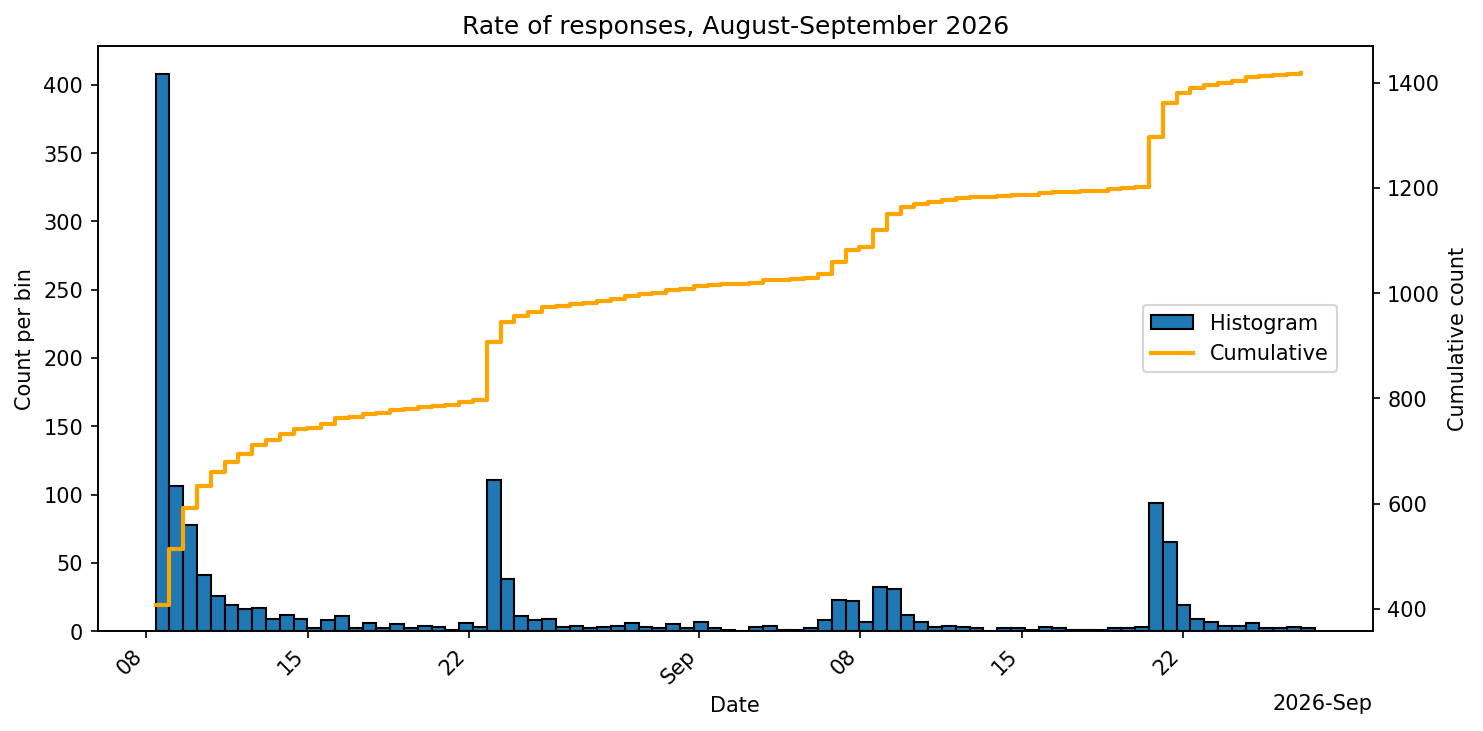
That’s about it. I hope you liked it. If you have any feedback, you can send us an email.
Btw, I created a Discord server for playing and contributing to a game inspired by Toki Pona designed to grow the Toki Pona community. This is a post about it.