The Logic behind Toki Pona
How does a tiny language work?

Artistic Center
Talk by jan Tamalu

Popularity

~14% of Esperanto speakers speak Toki Pona).
Discord Reddit Facebook Telegram In-person

Book

  • In 2014 first official book was published: A save point for how Toki Pona works.

pu (2014) book cover

Second book

  • Toki Pona grew during the pandemic and evolved a bit since then.
  • A small revision and community usage was recorded in a second book in 2021.

ku (2021) book cover

Toki Pona++: Writing systems

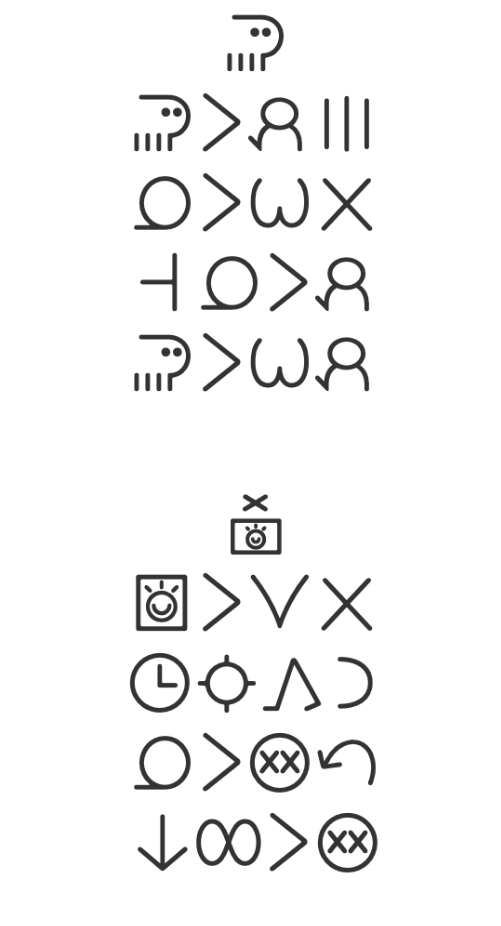
sitelen pona
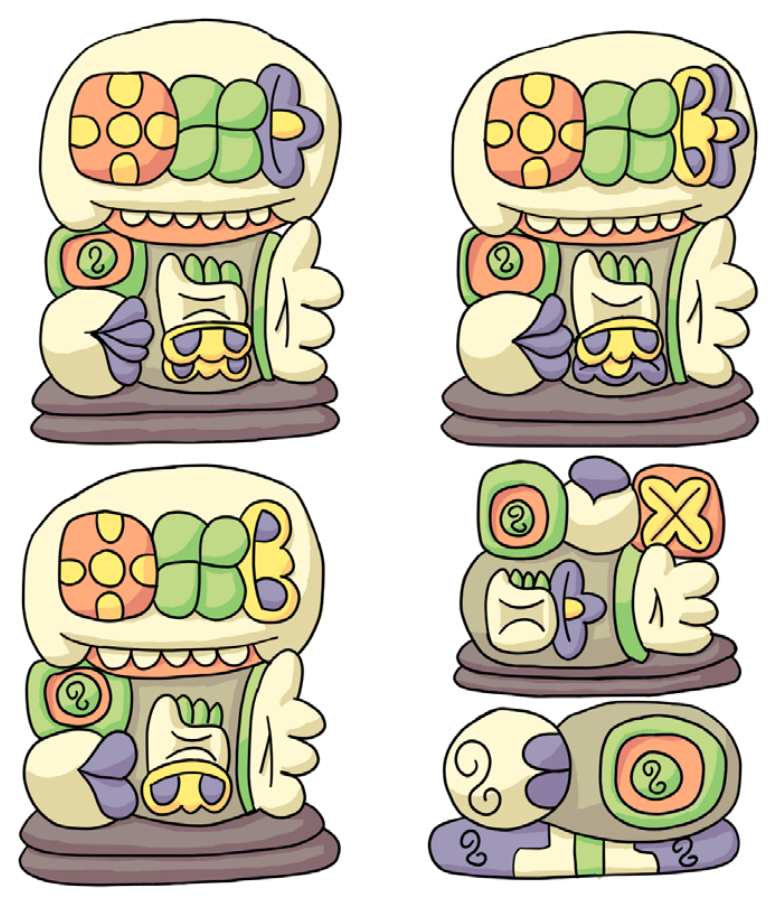
sitelen sitelen

Toki Pona++: A sign language

luka pona: A Toki Pona inspired sign language

Fallback: open on YouTube

Community - Where

Fallback: open the map

A MAGAZINE
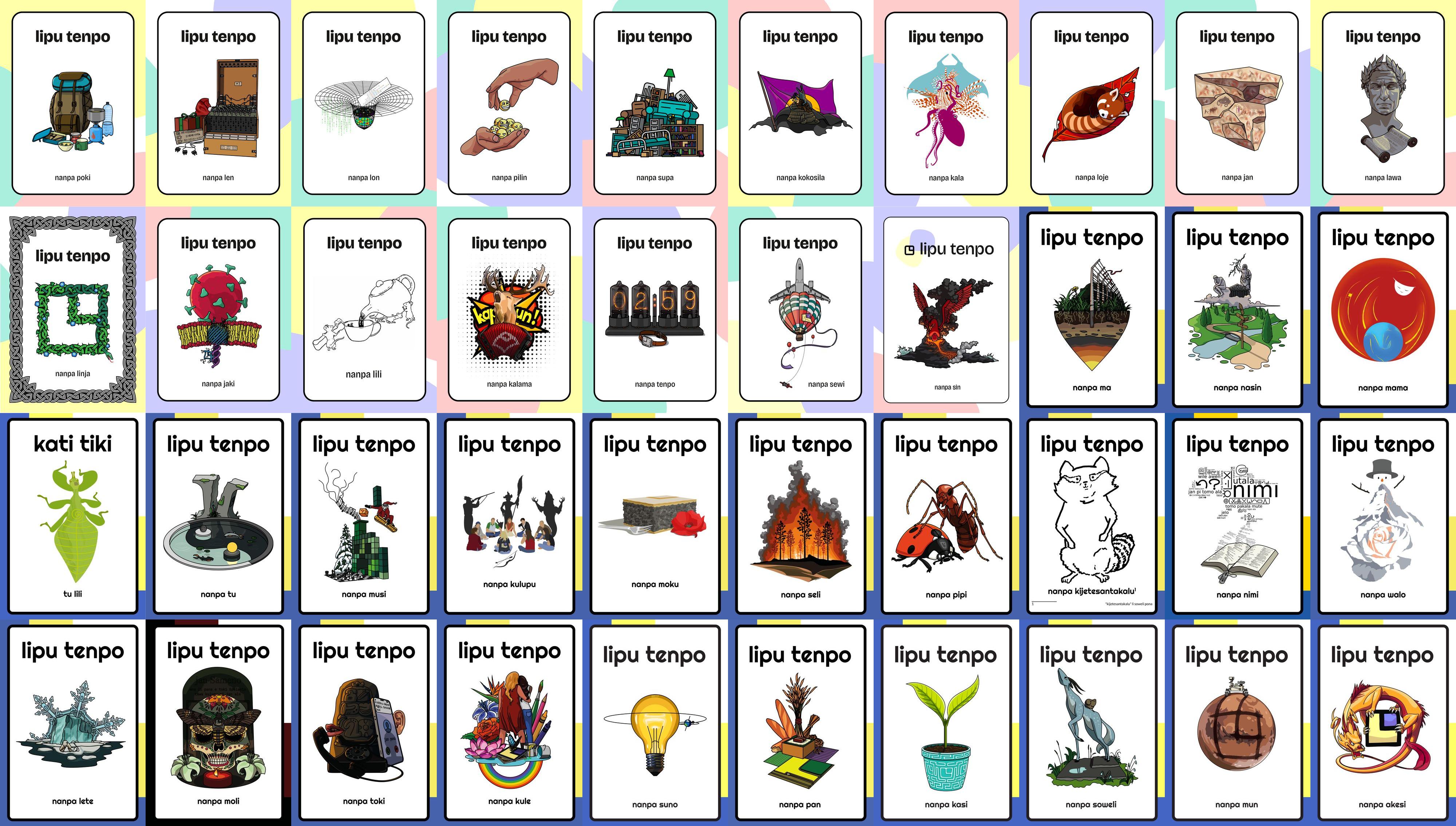
lipu tenpo magazine covers

Music in Toki Pona

Open the full playlist in Spotify

How does Toki Pona work?

(~65% of all Toki Pona rules)

Types of words

Content Words
  • moku: eat, drink, food
  • ike: bad, evil
  • toki: to talk, language, hello
  • mi: I, we, my, our...
  • jan: person
  • tawa: to move
Grammar particles
  • li, e, en, anu, la, o.

  • Introduce predicate (li), introduce direct object (e), separate subjects (en), or (anu), mark end of context (la), calling someone, commands, or wishes(o)

Meanings
mi suli meaning example

Noun Phrases

  • Several words without particles:
    • First one is a noun.
    • Next words modify all that came before.
tomo loje house red
red house
loje tomo red house
the redness of the house
jan utala suli (person fight) big
big warrior
jan utala suli ike ((person fight) big) evil
an evil big warrior

Noun Phrases

  • The particle pi alters parentheses:
jan utala suli (person fight) big
a big fighter
jan pi utala suli person (fight big)
a person of war, soldier
jan pi utala suli ike person ((fight big) bad)
a person of a bad war
jan ike pi utala suli (person bad) (fight big)
a bad person of war

Noun Phrases

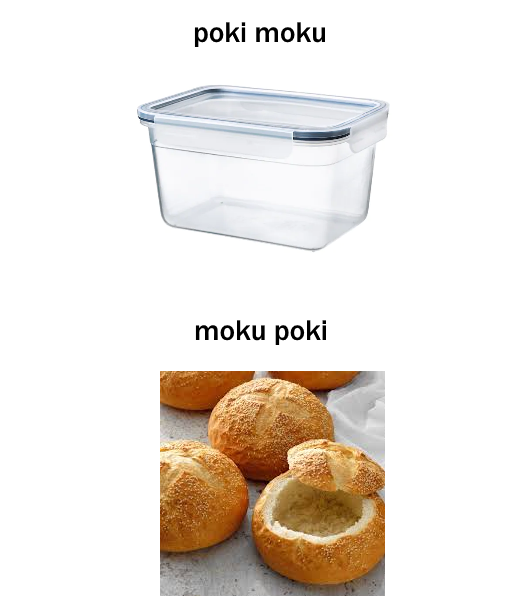
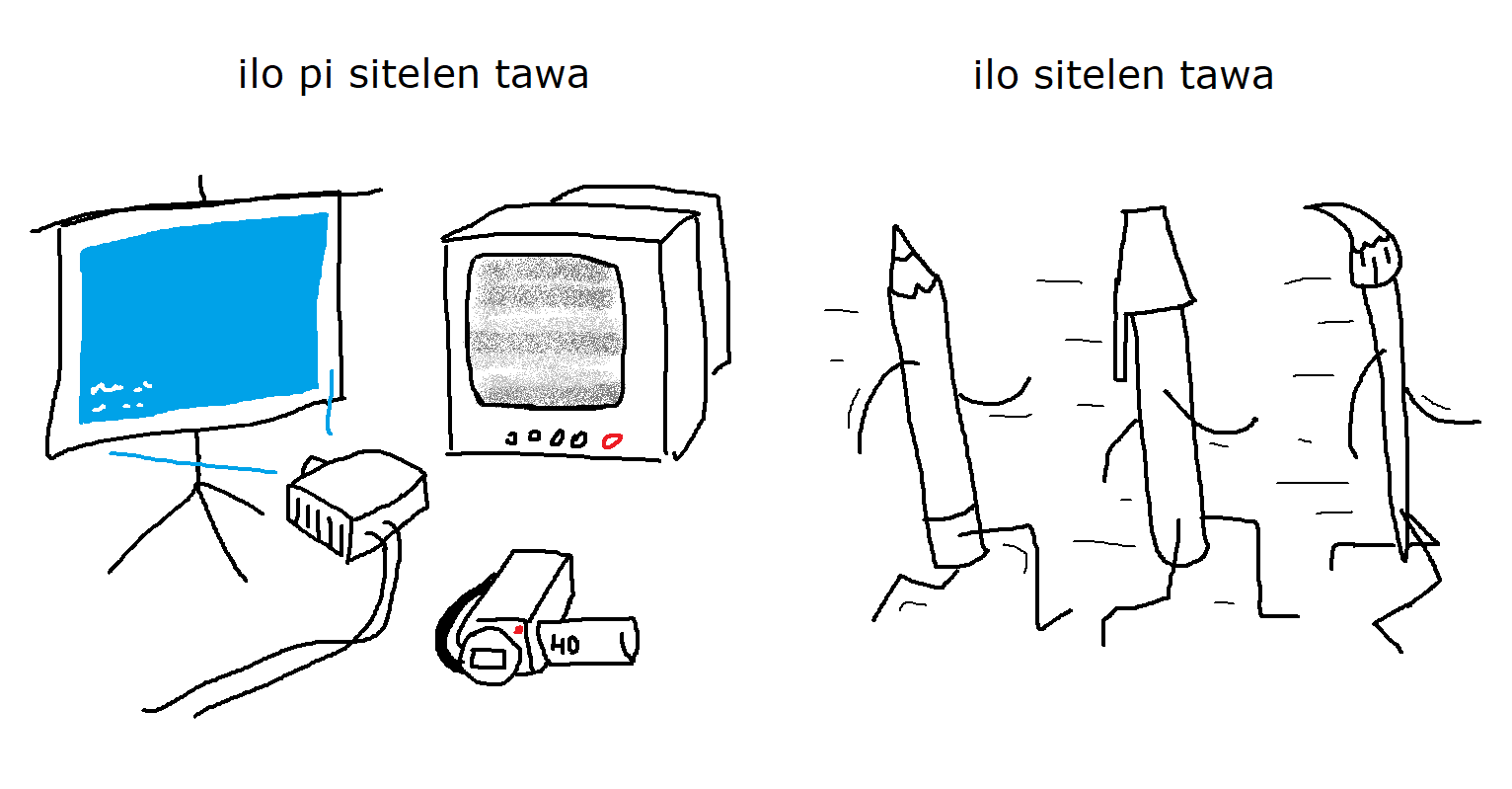
poki moku noun phrase

Noun Phrases

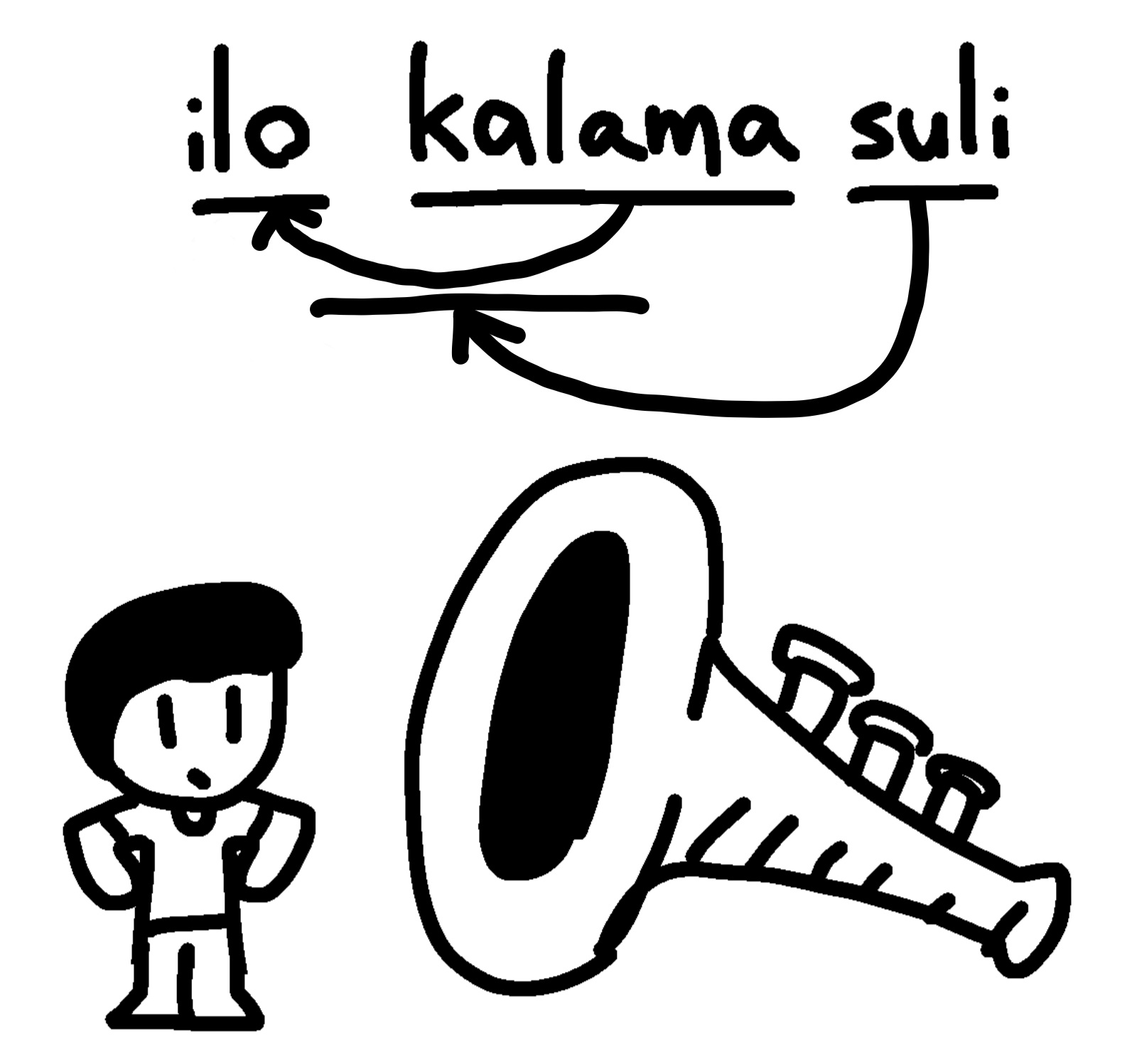
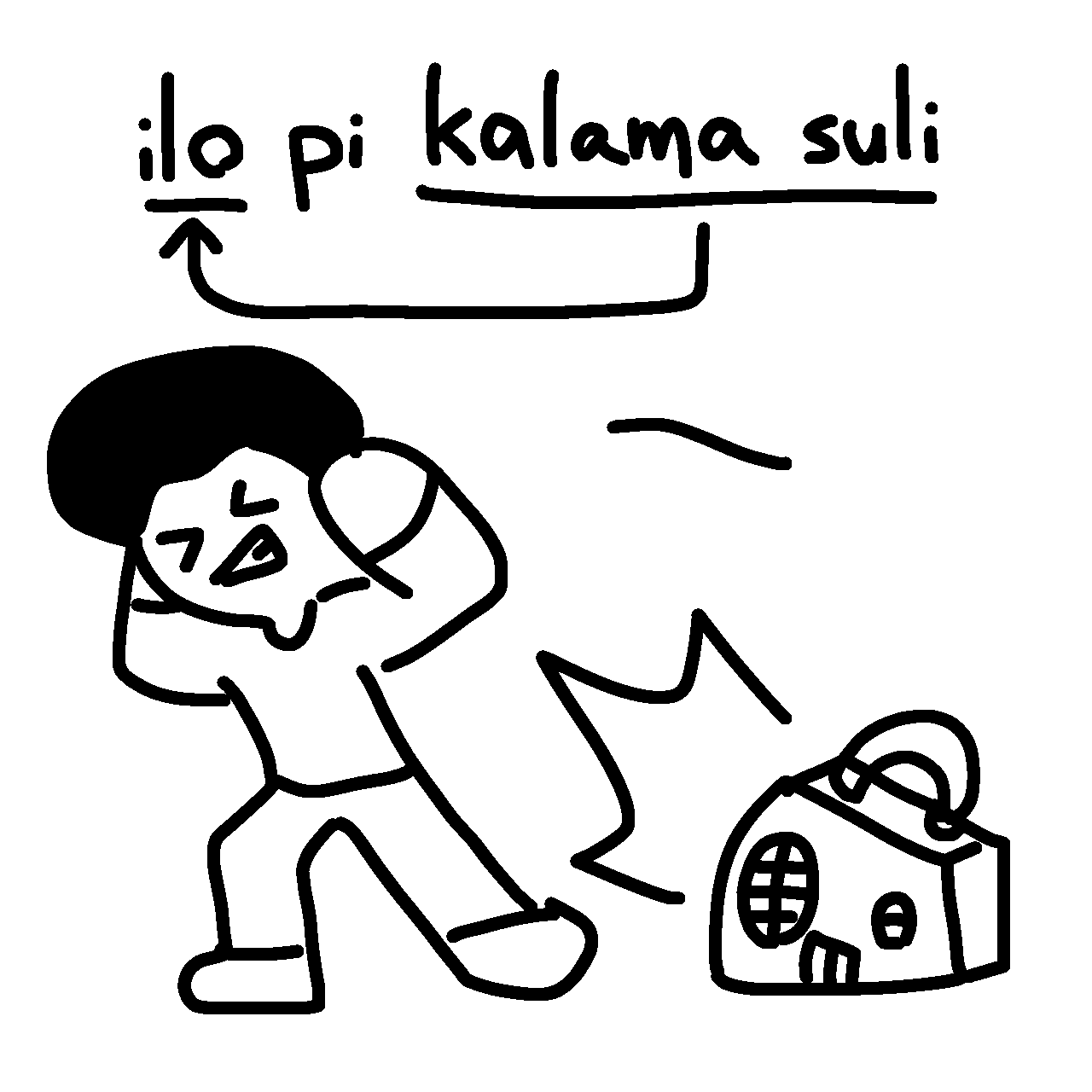
ilo kalama suli example
ilo pi kalama suli example

Noun Phrases

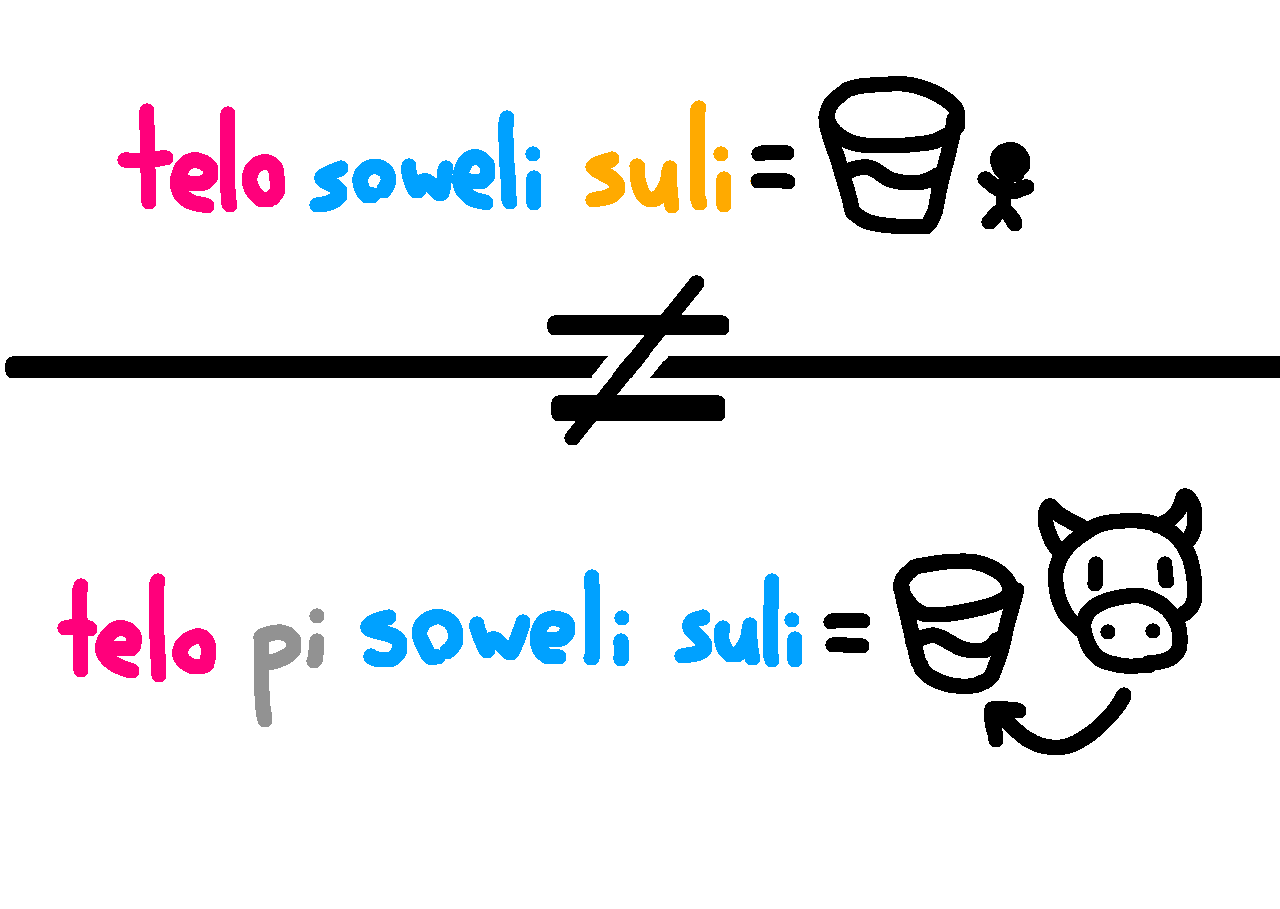
pi visual explanation

Noun Phrases

telo soweli suli example

Some other particles

  • en (and): separates sentence subjects
mi en sina I and you
you and I
soweli loje en jan suli (animal red) and (person big)
the red animal and the big person
  • anu (or)
telo kasi anu telo taso (water plant) or (water only)
tea or water

Verbs

  • Use li to introduce a verb or what things are.
  • A li B = A does B action (B is a verb)
kasi li moku plants li eat
plants eat
  • A li B = A is B
kasi li moku plants li food
plants are food
  • Qualifiers are allowed: A li B C (C qualifies B)
kasi li moku pona plant li (eat good)
plants are good food (or plants eat well)

Verbs

  • Exception: Only mi (I) or only sina (You) omit li:
mi sona I know
I know
sina toki mute you (speak many)
you speak a lot

Direct Objects

  • Add e + Noun Phrase after li + something to indicate an object the action is done to.
jan li moku e kili suwi person li eat e (fruit sweet)
a person eats a sweet fruit
mi lukin e tomo pi jan ni I see e (house of (person this))
I see this person's house

Prepositions

  • lon (in / at), tawa (toward), kepeken (using), sama (as, like), tan (because, from, by).
  • Another use of li: A li Preposition B
ona li lon tomo they li (at house)
they "at the house"
mi tawa nena ni I (toward (mountain this))
I "toward this mountain"
sina tan ma mi a you (from (land I !!))
you "from my land!"